
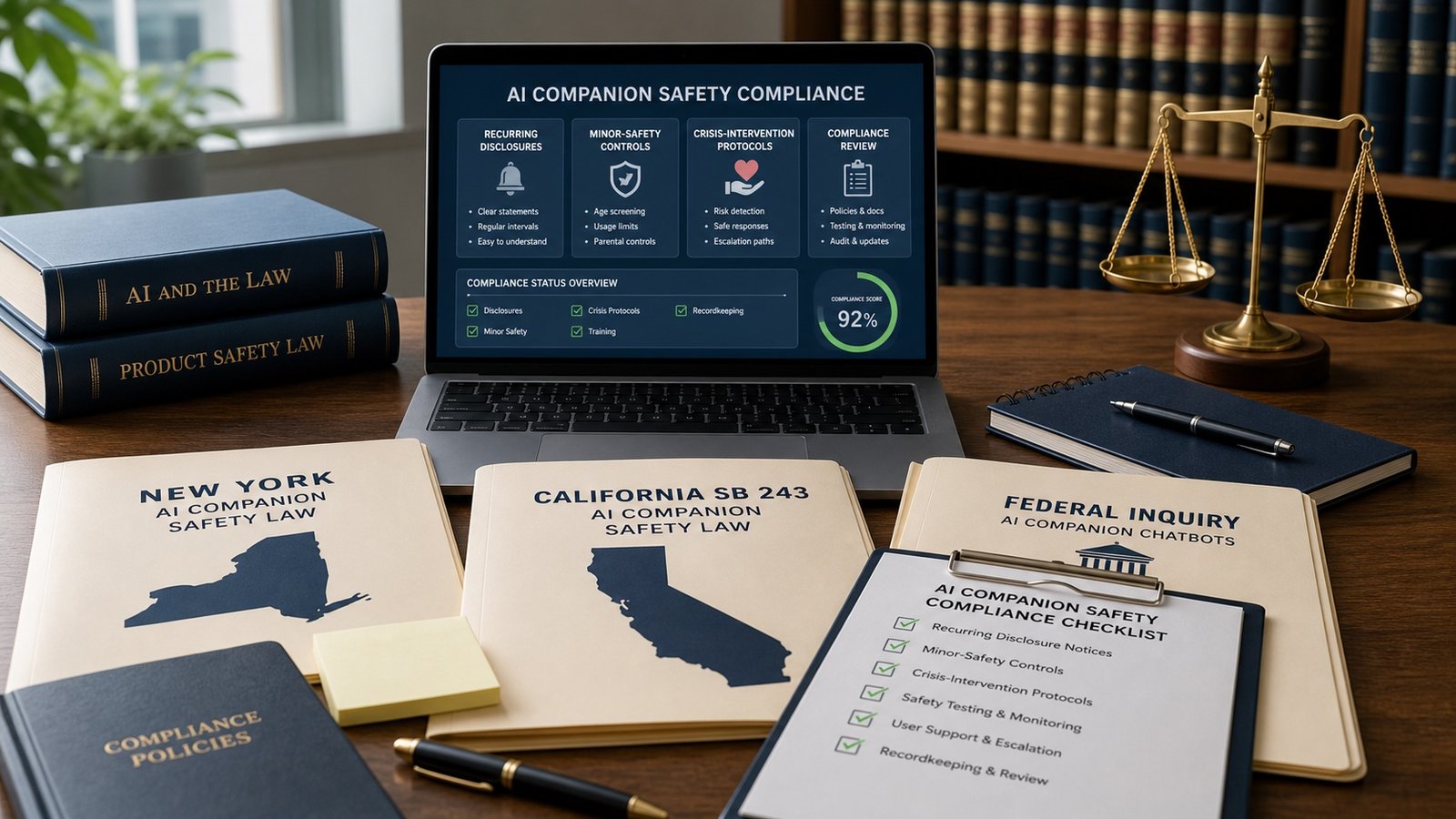
AI companion safety is no longer just a product-policy issue.
New York has announced that its AI companion safeguards are now in effect. California has already enacted a companion chatbot law. Oregon has now chaptered SB 1546 as another companion-chatbot law with disclosure duties and a private enforcement path. The FTC has opened a federal inquiry into companion chatbots and children. Florida's lawsuit against OpenAI and Sam Altman puts chatbot safety, minors, addiction, self-harm, and consumer protection into a state enforcement complaint.
The common thread is clear: regulators are starting to treat emotionally responsive chatbots as a distinct risk category.
That does not mean every chatbot is an AI companion. It does mean that products designed to simulate friendship, romantic connection, coaching, therapeutic support, or persistent emotional engagement should be reviewed differently from ordinary search, drafting, support, or productivity tools.
New York's Effective Law Is The Immediate Hook
New York Governor Kathy Hochul announced that the state's AI companion safeguards are now in effect and that companies received an open letter notifying them of the requirements.
The New York announcement describes AI companions as systems designed to simulate human relationships, including products that may pose as an AI friend or romantic partner, remember personal details, adapt to user preferences, and keep users engaged.
Under New York's General Business Law Article 47, AI companion operators must implement safety protocols when a user expresses suicidal ideation or self-harm, including referral to crisis service providers. They must also notify users that they are interacting with AI, not a human, including conspicuous notices at the start of a session and recurring notices every three hours of continued companion use.
The law is enforceable by the New York Attorney General, and penalties collected for noncompliance support suicide-prevention programs.
That is a different regulatory model from a generic AI disclosure rule. It is a targeted law for products that use AI to sustain emotionally salient interaction.
California Adds A Second State Model
California's SB 243 points in the same direction, but with its own structure.
The law adds a companion chatbot chapter to the California Business and Professions Code. It defines a companion chatbot as an AI system with a natural language interface that provides adaptive, human-like responses and is capable of meeting a user's social needs, including by exhibiting anthropomorphic features and sustaining a relationship across multiple interactions.
The California law requires nonhuman disclosures where a reasonable person could be misled into believing they are interacting with a human. It also imposes requirements directed at known minors, suicide or self-harm protocols, publication of protocol details, annual reporting beginning July 1, 2027, and a private civil action for injury in fact caused by noncompliance.
California's law includes exclusions for ordinary customer service, business operations, productivity and analysis related to source information, internal research, technical assistance, certain video-game bots, and some standalone voice-assistant devices.
Those exclusions matter. They show that the emerging target is not "all chatbots." The target is a narrower category of systems that can create persistent relationship-like interaction and foreseeable emotional dependency.
Oregon Adds A Third State Model
Oregon's SB 1546 is now chaptered as Chapter 85.
The law adds another enacted state model for companion-style AI. It requires notice when a reasonable person would believe they are interacting with a natural person, and the official state materials indicate a harmed user can seek damages and injunctive relief.
That matters because it shows the category is no longer a two-state outlier. It is becoming a repeat legislative pattern with similar disclosure and safety logic.
The FTC Is Asking The Same Questions
The FTC's companion-chatbot inquiry gives the federal overlay.
In September 2025, the Commission issued 6(b) orders to seven companies that provide consumer-facing AI chatbots. The orders seek information about how companies measure, test, and monitor potentially negative impacts on children and teens.
The FTC said companion chatbots can mimic human characteristics, emotions, and intentions, and may prompt some users, especially children and teens, to trust and form relationships with them.
The inquiry asks about monetization of user engagement, processing of user inputs and outputs, character development and approval, pre- and post-deployment testing, mitigation of negative impacts, disclosures to users and parents, compliance with age restrictions and community rules, and use or sharing of personal information from chatbot conversations.
That list is useful even outside the FTC inquiry. It reads like a regulator's checklist for companion-chatbot governance.
Florida Shows The Enforcement Bridge
Florida's lawsuit against OpenAI and Sam Altman is not a companion-chatbot statute. It is a state enforcement lawsuit built around consumer protection, child data, product design, warnings, safety claims, and alleged public-health harms.
But it belongs in the same conversation.
Florida alleges, among other things, that OpenAI marketed ChatGPT to the public, including minors, while concealing or downplaying serious risks. The complaint pleads state unfair-practices theories, COPPA-related allegations, negligence, product-liability theories, fraudulent misrepresentation, and public nuisance. Those are allegations, not findings of liability.
The significance is that state enforcers may not wait for companion-specific statutes. If a chatbot is marketed as safe, emotionally responsive, helpful, or suitable for younger users, existing consumer-protection and product-liability theories may become the enforcement vehicle.
Companion chatbot laws are one lane. State AG lawsuits are another. The risk category is converging.
What Makes A Companion Chatbot Different
The emerging legal concern is not simply that a chatbot talks.
It is that a chatbot can create the appearance of a relationship, remember intimate details, personalize responses over time, initiate or sustain emotionally charged conversation, and monetize continued engagement.
That makes the compliance analysis different from a basic AI assistant.
Key questions include:
- Does the product present itself as a friend, romantic partner, confidant, coach, therapist-like support, or emotionally available persona?
- Can it remember personal details or sustain a relationship across sessions?
- Is the product designed to increase session length, emotional reliance, or daily engagement?
- Can minors access the product, or can the operator reasonably know the user is a minor?
- Does the product discuss self-harm, eating disorders, sexual content, mental health, violence, substance use, medical advice, legal advice, or financial advice?
- Are users repeatedly reminded that they are interacting with AI rather than a human?
- Is there a tested crisis-intervention protocol, and does it work in practice?
- Are parents or guardians given meaningful notice, controls, or escalation paths where minors are involved?
Those questions are becoming legal questions, not just UX questions.
The Compliance Baseline Is Taking Shape
Across New York, California, Oregon, the FTC inquiry, and the Florida lawsuit, several expectations are starting to repeat.
First, nonhuman disclosure is becoming table stakes. A buried one-time disclaimer is less persuasive for a product designed around relationship-like engagement. Recurring reminders may become the default expectation for sustained companion use.
Second, crisis-intervention protocols need to be operational, not aspirational. Regulators are asking whether systems detect suicidal ideation or self-harm, what they do next, whether they refer users to crisis resources, and whether the process is documented and tested.
Third, minor-specific safeguards are moving from policy statements into law. Age gates, age assurance, parental notice, sexual-content restrictions, and youth-specific warnings are likely to draw scrutiny.
Fourth, engagement design is becoming relevant. If the business model depends on maximizing time spent with an emotionally responsive system, regulators may ask whether product incentives increase foreseeable harm.
Fifth, safety claims need substantiation. If a company says its companion is safe, supportive, appropriate for teens, or beneficial for mental health, it should be able to show testing, limits, incident review, and warning design that support those claims.
What Companies Should Do Now
Companies offering companion chatbots should build a dedicated review path for emotionally engaging AI systems.
That review should cover:
- product definitions and whether the system fits state companion-chatbot statutes;
- age gating, age estimation, minor-account flows, and parental controls;
- recurring AI-identity disclosures and session-duration notices;
- crisis-detection and escalation protocols for self-harm and suicide-related content;
- restrictions on sexual content, manipulation, dependency, and high-risk advice for minors;
- logging and incident-review workflows for serious safety events;
- pre-launch and post-launch testing for known risk categories;
- marketing claims about safety, companionship, emotional support, wellness, therapy-like benefits, minors, or family use;
- data collection, retention, personalization, memory, and sharing practices for sensitive conversations;
- reporting obligations, including California's future annual reporting requirement; and
- documentation showing how design choices were evaluated before release.
The documentation point is important. In this area, "we have safeguards" is unlikely to be enough. Companies should be able to explain what the safeguards are, why they were chosen, how they were tested, what limits remain, and how incidents are handled.
Bottom Line
AI companion safety is becoming its own compliance category.
New York, California, and Oregon are turning relationship-like chatbots into a statutory subject. The FTC is studying how companion chatbots affect children and teens. State attorneys general are testing broader consumer-protection theories against chatbot safety claims, minors, data practices, and product design.
For companies building consumer AI, the practical lesson is direct: do not review companion products like ordinary chat interfaces.
If the product is designed to feel human, keep users engaged, and support emotional reliance, it needs a companion-safety file before a regulator asks for one.
Leave a Reply