
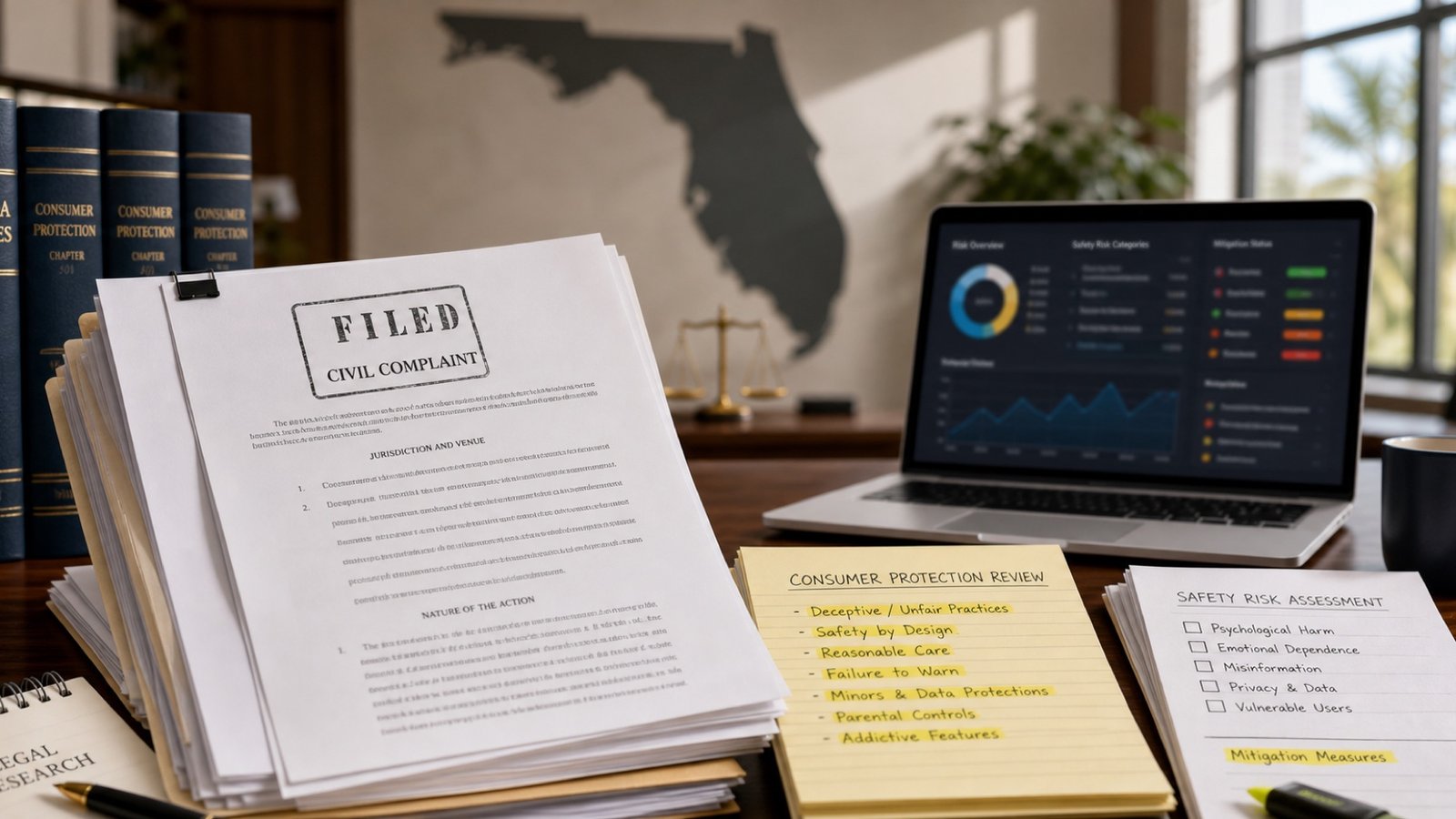
Florida's lawsuit against OpenAI and Sam Altman is a state attorney general trying to turn chatbot safety into a consumer-protection, child-data, product-liability, and public-nuisance case.
The complaint is only allegations. OpenAI and Altman have not been found liable. But the filing is still important because it shows how state enforcers may try to use existing legal tools against AI products without waiting for a comprehensive AI statute.
The theory is direct: if a company markets a consumer chatbot as safe, reliable, useful for minors, or emotionally responsive, then product design, warnings, age controls, data collection, and safety testing may become consumer-protection issues.
What Florida Filed
The Florida Attorney General announced a civil action against several OpenAI entities and Sam Altman in Florida state court. The release describes it as a first-in-the-nation state-led lawsuit against OpenAI and its CEO.
The state alleges that OpenAI knowingly released and aggressively marketed ChatGPT to the public, including children, while concealing serious risks and downplaying the danger of the product.
The complaint seeks damages, civil penalties, injunctive relief, and abatement of an alleged public nuisance. It also says the state is pursuing the civil action separately from an ongoing Office of Statewide Prosecution criminal investigation relating to chat logs reviewed after the Florida State University shooting.
That distinction matters. The civil lawsuit is not a criminal charge. It is also not a court finding that ChatGPT caused any specific harm. It is an enforcement complaint that still has to survive litigation.
The Claims Are Broader Than Deception
The complaint starts with Florida's Deceptive and Unfair Trade Practices Act, but it does not stop there.
Florida pleads several FDUTPA theories. It alleges unfair practices, unconscionable practices, deceptive practices, and a FDUTPA theory tied to alleged violations of COPPA and its implementing regulations.
The complaint also pleads negligence, gross negligence, strict liability for design defect, strict liability for failure to warn, fraudulent misrepresentation, and public nuisance.
That mix is the real story. Florida is not only saying "the marketing was misleading." It is saying the chatbot's design, deployment, safeguards, age access, warnings, and data practices belong inside the enforcement case.
For AI companies, that is the move to watch. State AGs do not need an AI-specific statute if they can plead old claims around new product behavior.
The Minor-Data Theory
One of the most concrete parts of the complaint is the child-data theory.
Florida alleges that OpenAI has actual knowledge that children under 13 use ChatGPT, that users can input false dates of birth, and that OpenAI collects personal data through user conversations. The complaint says OpenAI fails to provide adequate notice to parents and fails to obtain verifiable parental consent before collecting or using children's personal information.
Florida frames that as a FDUTPA issue by pointing to COPPA. The complaint says the state is not bringing a direct COPPA enforcement claim. Instead, it alleges that conduct violating COPPA and its rules can serve as an unfair practice under Florida law.
That is a practical warning for consumer AI products. Even when the immediate lawsuit is brought under a state unfair-practices statute, federal child-privacy standards may still shape what the state calls unfair.
The risk is especially sharp for products that:
- are available to minors;
- collect conversational, audio, image, location, health, or other personal data;
- use memory or personalization features;
- do not require robust age assurance;
- depend on voluntary parental linking rather than default parental oversight; or
- are marketed as helpful, supportive, educational, or safe for young users.
The Safety-Representation Theory
Florida also attacks safety messaging.
The complaint alleges that OpenAI represented safety as part of its mission and made statements suggesting ChatGPT helps keep teens safe by default. Florida says those statements were misleading because, in its view, ChatGPT can produce dangerous responses, encourage unhealthy use, and create risks for minors and vulnerable users.
This is a familiar consumer-protection structure applied to an AI product. A company does not need to promise perfection to create legal exposure. If it makes safety a selling point, regulators may ask whether the product design, warnings, testing, and deployment record match the claim.
That is why AI companies should treat safety language like a substantiation problem. Claims such as "safe," "trusted," "reliable," "age appropriate," "guardrailed," "supervised," or "keeps teens safe" should be tied to evidence, limits, and current product behavior.
The more sensitive the use case, the more careful the claim needs to be.
The Product-Liability Move
The complaint also tries to treat ChatGPT as a product for purposes of strict product liability.
Florida alleges design defect and failure to warn. It says ordinary consumers would not expect a generative AI chatbot to proactively provide suggestions about self-harm or violence, or to contribute to cognitive decline or behavioral addiction in teenagers. It also alleges that risks could have been reduced by reasonable alternative designs and better safety testing.
Those are allegations, and they raise hard questions that courts will have to confront. Is a generative AI service a product for strict-liability purposes? What counts as a design defect in a probabilistic model? What warnings are adequate for a general-purpose chatbot? How should courts treat intervening user conduct, misuse, and causation?
Those questions are unsettled. But the fact that a state AG is pleading them matters.
The next wave of AI litigation will not be limited to privacy claims or deceptive marketing. Plaintiffs and regulators will test whether product-liability doctrines can reach model behavior, release decisions, safety tradeoffs, and warning design.
The Public-Nuisance Theory
Florida's public-nuisance claim is also worth watching.
The complaint alleges that the design and function of ChatGPT, including alleged encouragement of self-harm, violence, eating disorders, AI addiction, cognitive decline, and other harms, created a public nuisance affecting health and safety in Florida.
Public nuisance has become a common tool in large public-harm litigation, but it is also heavily contested. Courts have not uniformly accepted efforts to use nuisance law for products or technology platforms. OpenAI will almost certainly challenge the theory.
Even so, the claim signals how state enforcers may frame AI harm: not only as individual injury, but as a public-health and public-safety problem.
That framing fits the broader state trend around companion chatbots, minors, crisis-intervention protocols, and recurring AI disclosures.
For a closer look at that related trend, see Clearon's analysis of AI companion safety as an emerging compliance category.
Why This Is Different From A Private Product Case
The lawsuit matters partly because of who filed it.
A private plaintiff usually has to prove individual injury, causation, damages, and standing. A state attorney general can frame the case around public enforcement, civil penalties, injunctive relief, public interest, and statewide consumer harm.
That changes the litigation posture. It also changes the remedy discussion.
Florida is asking for orders that would stop alleged misrepresentations, restrict collection and processing of data from children under 13 without notice and verifiable parental consent, require warnings about risk, and impose monetary relief. The complaint also seeks civil penalties up to $10,000 per FDUTPA violation and other damages or equitable relief.
Whether Florida can obtain those remedies is a merits question. But the requested relief shows what state enforcers may want from consumer AI companies: not just money, but changes to product design, data handling, warnings, and minor-safety defaults.
What AI Companies Should Do Now
The safest response is not to treat this as a one-off Florida fight.
Consumer AI companies should review:
- safety claims in marketing, help pages, launch posts, investor materials, and teen/minor-facing materials;
- age-gating, age-estimation, and minor-account flows;
- parental notice, consent, and oversight features;
- memory, personalization, and conversational-data retention practices;
- chatbot responses involving self-harm, violence, eating disorders, mental health, drugs, weapons, legal advice, medical advice, and financial advice;
- release-readiness records for major model updates;
- incident escalation and red-team documentation;
- warnings and user-facing disclosures for risky uses; and
- how crisis-intervention protocols work in practice.
This does not mean every chatbot is illegal or every safety failure is an unfair practice. It does mean that consumer AI products should be able to explain what they knew, what they tested, what they warned, what they blocked, and how they treated minors.
That record will matter if an AG, plaintiff, regulator, or court asks whether the product was marketed and deployed responsibly.
Bottom Line
Florida v. OpenAI is early-stage litigation, not a judgment.
It is still a concrete sign that state AGs are beginning to treat chatbot safety as ordinary consumer protection, not as a futuristic AI policy question.
For companies building consumer-facing AI, the lesson is simple: safety claims, child-data practices, warnings, and release decisions are legal artifacts. They should be reviewed like legal artifacts before they become exhibits.
Sources
- Florida Attorney General announcement
- Filed complaint linked by the Florida Attorney General
- Complaint mirror used for text extraction
Leave a Reply