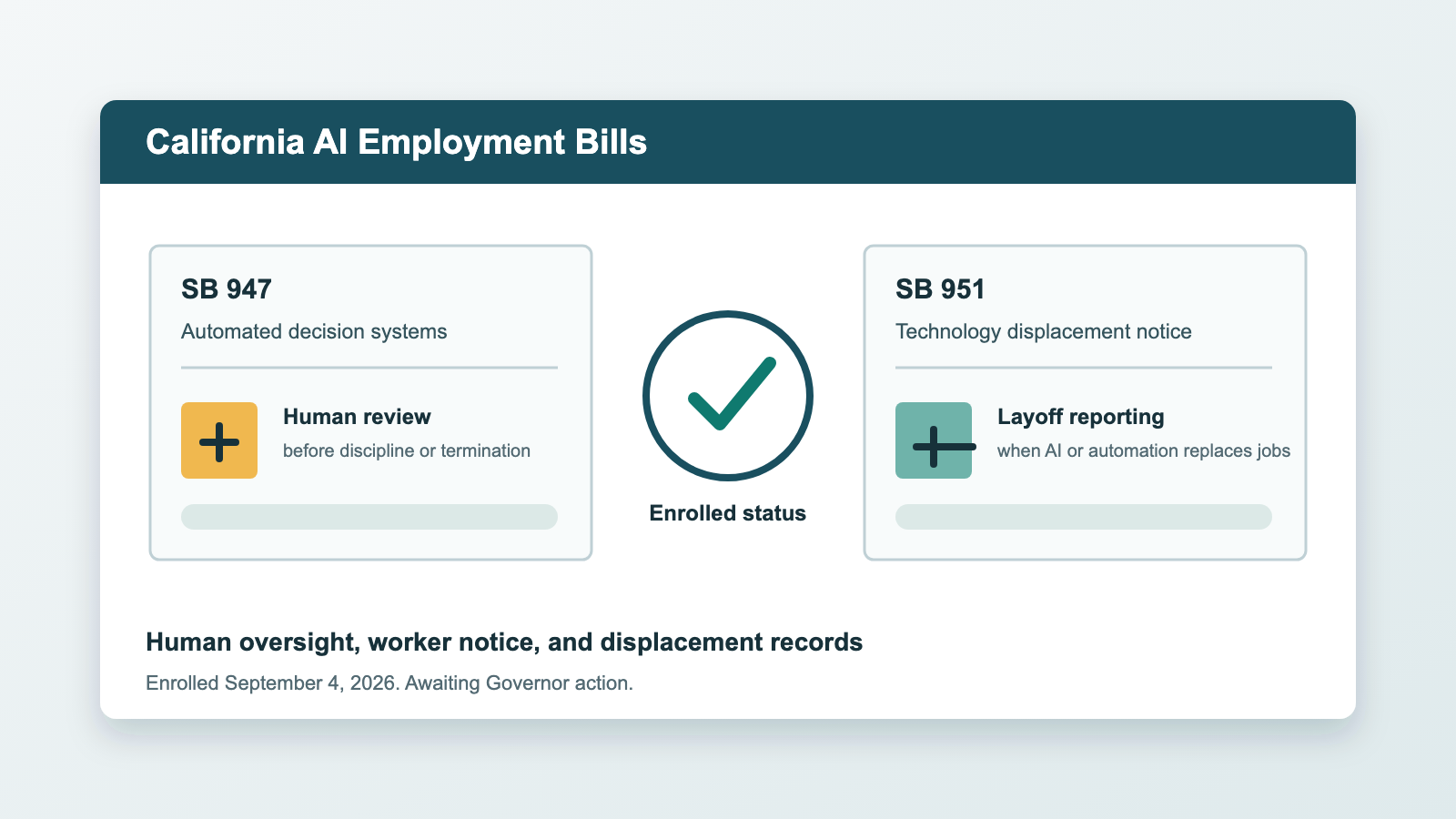
California now has two AI employment bills at enrolled status.
That matters because the pair does not try to regulate workplace AI as one abstract category. It targets two concrete points where automation changes employment power: discipline or termination decisions, and workforce reductions caused by AI or other automated technology.
SB 947 would bar employers from relying solely on automated decision systems to discipline or fire workers and would require human review when an employer primarily relies on automated decision system output. SB 951 would add AI-driven or automation-driven displacement information to California's mass-layoff notice framework when a covered Cal-WARN notice is already required.
Both bills are still awaiting executive action. They are not enacted law yet. But the official California records show both measures enrolled on September 4, 2026, after final Senate concurrence votes on August 31. That makes this a live compliance-planning moment, not another introduced-bill story.
For companies using workforce AI, the direction is clear enough already. California is moving from "should employers use AI carefully?" to "who reviews the automated output, what must the worker be told, and what public records will exist when automation displaces jobs?"
What Changed This Week
The official California bill records show SB 947 and SB 951 both reached enrolled status on September 4, 2026.
SB 947, titled "Employment: automated decision systems," passed after Assembly amendments were concurred in by the Senate on August 31 by a 28-10 vote. The official Legislative Counsel's Digest says the bill would add a new Labor Code part beginning July 1, 2027.
SB 951, titled "Employment: technological displacement: notice," also reached enrolled status on September 4 after Senate concurrence in Assembly amendments on August 31, by a 29-10 vote.
Those statuses matter because the legislative question has narrowed. The bills are no longer merely concepts being debated in committee. They are passed measures awaiting executive action.
That does not make them binding yet. It does make them serious enough that companies should begin mapping whether their workforce systems would fall within the rules if the bills are signed.
SB 947 Is About AI in Discipline and Termination
SB 947 is the more direct "robo boss" bill.
The official digest says the bill would, beginning July 1, 2027, prohibit an employer from using an automated decision system to perform certain functions and limit the purposes for and way in which such a system may be used. It would also create employee rights around the data used by the system when the employer primarily uses an automated decision system to make a disciplinary or termination decision.
The bill is more than a ban on a fully automated firing button. It is also a documentation and notice bill.
When an employer primarily uses an automated decision system to make a disciplinary or termination decision, the bill would allow the affected employee to request a description of the employee's own data primarily used by the system. It would also require a written post-use notice when an employer primarily relied on an automated decision system to make the decision.
The author's office frames the bill more plainly. Senator Jerry McNerney's announcement says SB 947 would bar employers from relying solely on automated decision systems to fire or discipline workers, require human oversight and verification when such systems assist those decisions, and require employers to inform workers if an automated decision system was used.
The enforcement structure also matters. The official digest says the Labor Commissioner could enforce the bill and a public prosecutor could bring a civil enforcement action. The author's announcement says the bill does not provide a private right of action.
For employers, that combination points to a regulatory file rather than just a lawsuit file. If the bill is signed, companies will need to show how the human review worked, what notice was given, what data description can be produced, and why the automated system was not treated as the final unreviewed decision maker.
SB 951 Is About AI-Driven Job Displacement
SB 951 addresses a different problem: not the individual disciplinary decision, but the larger workforce event.
The official status page describes SB 951 as a bill on "Employment: technological displacement: notice." The bill text would amend California's mass-layoff notice framework so that, when an employer is already required to issue notice for a mass layoff, relocation, or termination, and that event is caused in whole or in substantial part by an AI system or other automated technology replacing or automating employment positions, the notice must include additional information.
That information would include:
- the number, classification or occupation, and work location of layoffs substantially due to replacement or automation by AI or other automated technology;
- the job functions performed by the replaced workers that will be automated;
- the specific category or type of AI system or other automating technology that substantially resulted in technological displacement; and
- a statement at the top of the notice saying, "This notice is for a technology displacement."
The bill would also require California's Employment Development Department, as part of regular Cal-WARN Act data reporting, to publish a summary of notices received under the new technological-displacement subdivision and post quarterly statewide summaries of reported technology displacements.
That is a major practical point. SB 951 would add a public reporting trail about AI-related and automation-related displacement.
For companies, that means the decision to attribute a layoff to AI or automation may become visible outside the company. For policymakers, researchers, unions, journalists, and competitors, the same notices could become a data source about where automation is actually replacing jobs.
The Two Bills Should Be Read Together
SB 947 and SB 951 are stronger together than either bill is alone.
SB 947 focuses on decision quality and worker process when an automated decision system is used in discipline or termination. SB 951 focuses on transparency when technology changes the structure of the workforce.
One is about the affected worker asking: was an automated system used against me, and what data did it rely on?
The other is about the affected workforce, government, and public asking: are jobs being eliminated because AI or automation is replacing them, and where is that happening?
That is the real story. California is moving beyond product-level workplace AI regulation and into the evidence trail around workplace AI.
Employers will not be able to treat these questions as purely internal design choices if the bills are signed. The practical burden will sit in HR, legal, compliance, procurement, data governance, labor relations, and workforce planning.
This Fits a Broader State Pattern
California is not moving in isolation.
Colorado's 2026 automated decision-making technology law, which replaces the state's earlier high-risk AI framework, also turns on notice, explanations, data correction, and meaningful human review. Illinois already regulates certain employment uses of artificial intelligence through amendments to the Illinois Human Rights Act. New York City has had its automated employment decision tool law in force for several years.
The California bills would add a different kind of pressure.
SB 947 would push into discipline and termination, beyond the hiring focus of many employment-AI laws. SB 951 would push into displacement reporting through Cal-WARN notices. Together, they would make employment AI governance a continuing operational requirement rather than a one-time vendor review.
That matters because many organizations still treat AI employment risk as a hiring-screening issue. The newer pattern is broader. It covers who is evaluated, who is disciplined, who is terminated, who is replaced, and what records prove the company did not let automated systems quietly make the real decision.
What Companies Should Do Before Signature
Companies do not need to wait for final enactment to start the useful work.
The first step is inventory. Employers should identify systems that rank, score, recommend, flag, classify, monitor, or otherwise influence discipline, performance management, termination, layoffs, redeployment, or workforce planning.
The second step is role mapping. A tool that merely stores employee records is different from a tool that recommends termination, flags productivity concerns, scores performance, identifies positions for elimination, or produces a workforce-reduction plan.
The third step is human-review design. If a system can affect discipline or termination, the company should be able to say who reviews the output, what information the reviewer sees, what discretion the reviewer has, and how the company records the human judgment.
The fourth step is notice and data-description readiness. If a worker can ask for a meaningful, objective description of the employee's own data that the system primarily used, the company needs to know whether that description can be produced without exposing unrelated confidential or third-party information.
The fifth step is displacement classification. If AI or automated technology contributes to layoffs or job eliminations, the company should decide how it will determine whether the technology caused the event "in whole or in substantial part." That phrase is likely to do a lot of work if SB 951 becomes law.
What Not To Overstate
There are three cautions.
First, neither bill is enacted yet. The Governor can still sign, veto, or otherwise affect the final posture. The right status today is enrolled and awaiting executive action.
Second, SB 947 should not be described as banning all AI use in employment decisions. The official materials point to limits, human oversight, worker notice, and data-description rights around covered uses, especially discipline and termination.
Third, SB 951 is not a general anti-automation law. It is a notice and reporting bill tied to covered Cal-WARN mass-layoff and related events caused in whole or in substantial part by AI systems or other automated technology.
Those limits make the bills more useful, not less. They show where the compliance work will actually sit.
Bottom Line
California's latest AI employment package is about control and records.
SB 947 asks whether a human really reviewed the automated decision system output that helped discipline or fire a worker, and whether the worker gets notice and a meaningful description of the employee data primarily used around that use. SB 951 asks whether AI or automation materially contributed to displacement in a covered Cal-WARN event and whether that fact will be reported through the state's layoff-notice system.
If both bills are signed, California will add another important layer to workplace AI governance: whether the company can show who relied on the tool, who reviewed its output, what the worker was told, and what the public record says when technology replaces jobs.
That is a much harder problem than updating an AI policy. It is a workflow problem. Companies that use automated systems in employment decisions should treat it that way now.
Sources and Related Clearon Coverage
- California SB 947 status page
- California SB 947 bill text
- California SB 951 status page
- California SB 951 bill text
- California Senator McNerney press release on SB 947
- https://clearon-ai.com/colorado-replaced-ai-act-admt/
- https://clearon-ai.com/workday-ai-screening-vendor-liability/
- https://clearon-ai.com/ai-transparency-common-rule/