Michigan now has a published appellate opinion on AI-generated fabricated and unsupported legal authority.
In Barber v. Morawa, the Michigan Court of Appeals affirmed the denial of a motion for a new trial or evidentiary hearing in a medical-malpractice case. The merits were not the real story. The court separately sanctioned plaintiff's counsel for repeatedly submitting fabricated and unsupported authority that counsel attributed to over-reliance on artificial intelligence.
The opinion matters because it moves the issue from a general warning to a Michigan-specific appellate holding. Counsel's repeated submission of fabricated and unsupported authority violated MCR 7.216(C)(1) and MCR 1.109(E)(5). The case was remanded for a determination of actual damages and reasonable attorney fees incurred because of the appeal, payable personally by counsel. The court also directed its clerk to forward the opinion to the Attorney Grievance Commission for possible investigation.
What Went Wrong
The underlying case involved alleged juror misconduct after a civil medical-malpractice trial. The plaintiff sought a new trial or evidentiary hearing, but the allegations depended on facts outside the record and were not supported by valid affidavits.
The court resolved that merits issue without much difficulty. The harder issue was counsel's briefing.
The court said counsel cited fabricated authority in a motion for a protective order, then cited fabricated authority again in a motion for a new trial or evidentiary hearing. Defendant identified the problem and requested sanctions.
The pattern continued on appeal. Counsel cited a nonexistent Michigan case and repeatedly cited real authorities for propositions they did not support. After defendant identified the defects in the appellee brief, counsel filed a reply without acknowledging the fabricated case or correcting the unsupported assertions.
Months later, counsel filed a "Notice of Correction." That notice accepted responsibility and attributed the citation errors to over-reliance on AI research tools. But it still did not solve the problem. The court said the notice, also prepared with AI assistance, attributed quotations and legal propositions to cases that did not contain them.
Why The Published Opinion Matters
The court did not create an AI-specific exception. It did not create an AI safe harbor either.
Instead, it applied existing Michigan rules. Under MCR 1.109(E)(5), a lawyer's signature certifies that the lawyer has read the document and that, after reasonable inquiry, it is well grounded in fact and warranted by existing law. The reasonableness standard is objective. Good faith is not enough.
The court also relied on MCR 7.216(C)(1), which allows sanctions when an appeal or appellate proceeding is vexatious because a brief grossly disregards the requirements of fair presentation, violates court rules, or is grossly lacking in propriety.
The holding is direct: submitting fabricated and unsupported authority through over-reliance on AI violates the duty of reasonable inquiry.
That matters for Michigan practitioners because the opinion translates national AI-sanctions principles into Michigan appellate procedure.
The Correction Filing Lesson
The most practical part of Barber may be the failed correction filing.
Once opposing counsel or a court identifies fabricated authority, the next filing should not be treated as ordinary cleanup. It should be treated as a controlled remediation event.
That means:
- stop using the same unverified AI workflow that created the problem;
- identify every disputed citation, quotation, and proposition;
- review original sources directly;
- state exactly what was wrong and what is being corrected;
- avoid substituting new authority unless it has been read and verified; and
- have a lawyer with responsibility for the filing own the correction.
In Barber, the correction filing became evidence that the verification problem had not been fixed.
What Michigan Lawyers Should Do Now
Michigan litigators should assume that AI-assisted briefing is subject to the same reasonable-inquiry requirement as any other filing.
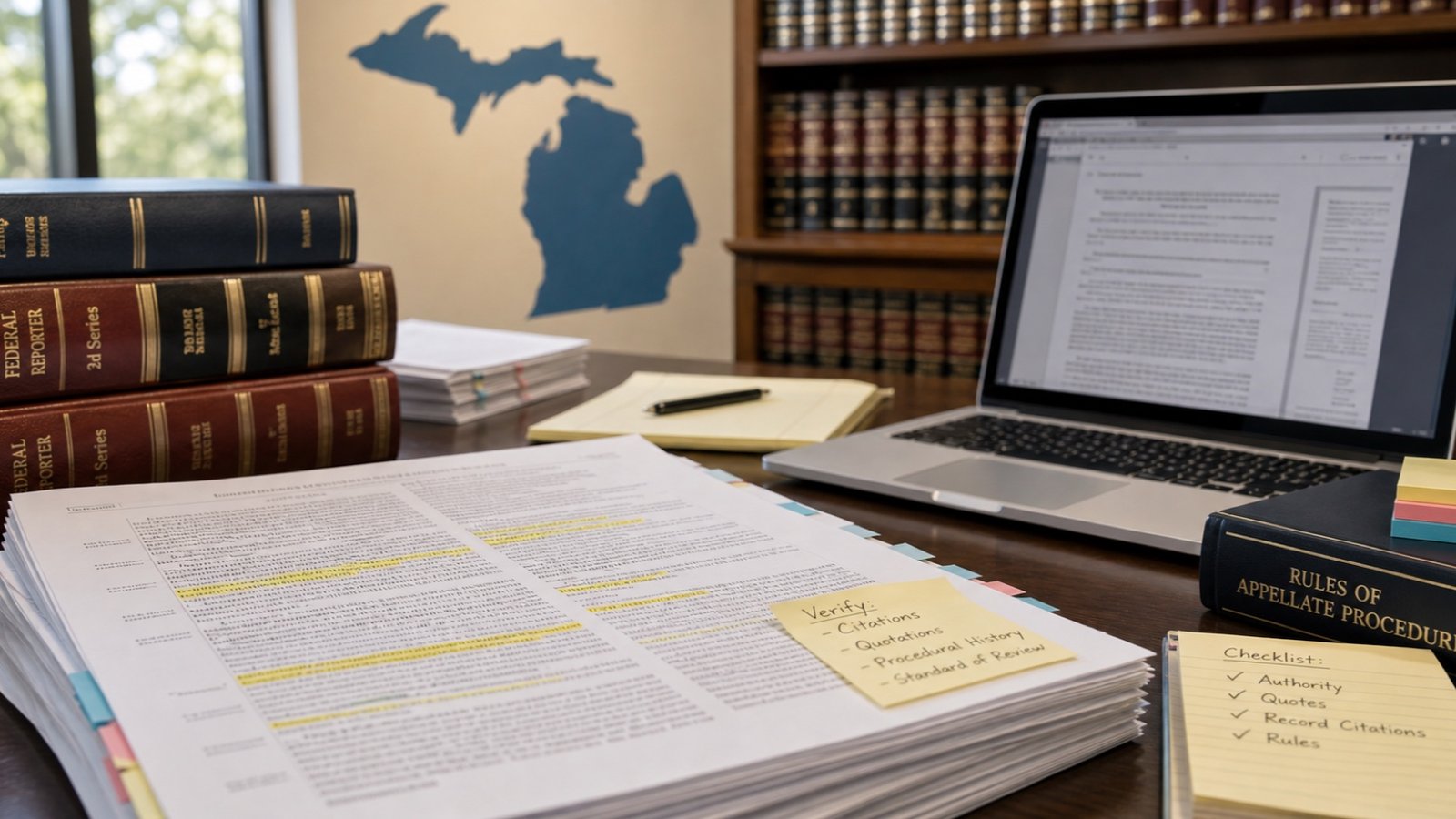
Before filing, counsel should verify not only that a case exists, but also that:
- the quoted language appears in the case;
- the case actually supports the proposition asserted;
- the procedural posture is accurately described;
- the cited rule or statute is current;
- factual assertions and record references match the record; and
- criminal cases are not being used to import inapplicable constitutional standards into civil proceedings.
Law firms should also decide who is responsible for verification. Delegating a first draft to AI, staff, or a junior team member does not delegate the signing lawyer's duty.
Bottom Line
Barber v. Morawa is not a ban on AI in Michigan litigation. It is a published reminder that AI does not lower the standard for signed filings.
For Michigan lawyers, the rule is straightforward: read the authorities, verify the quotations, and do not file a correction until the correction has itself been checked.
Leave a Reply