
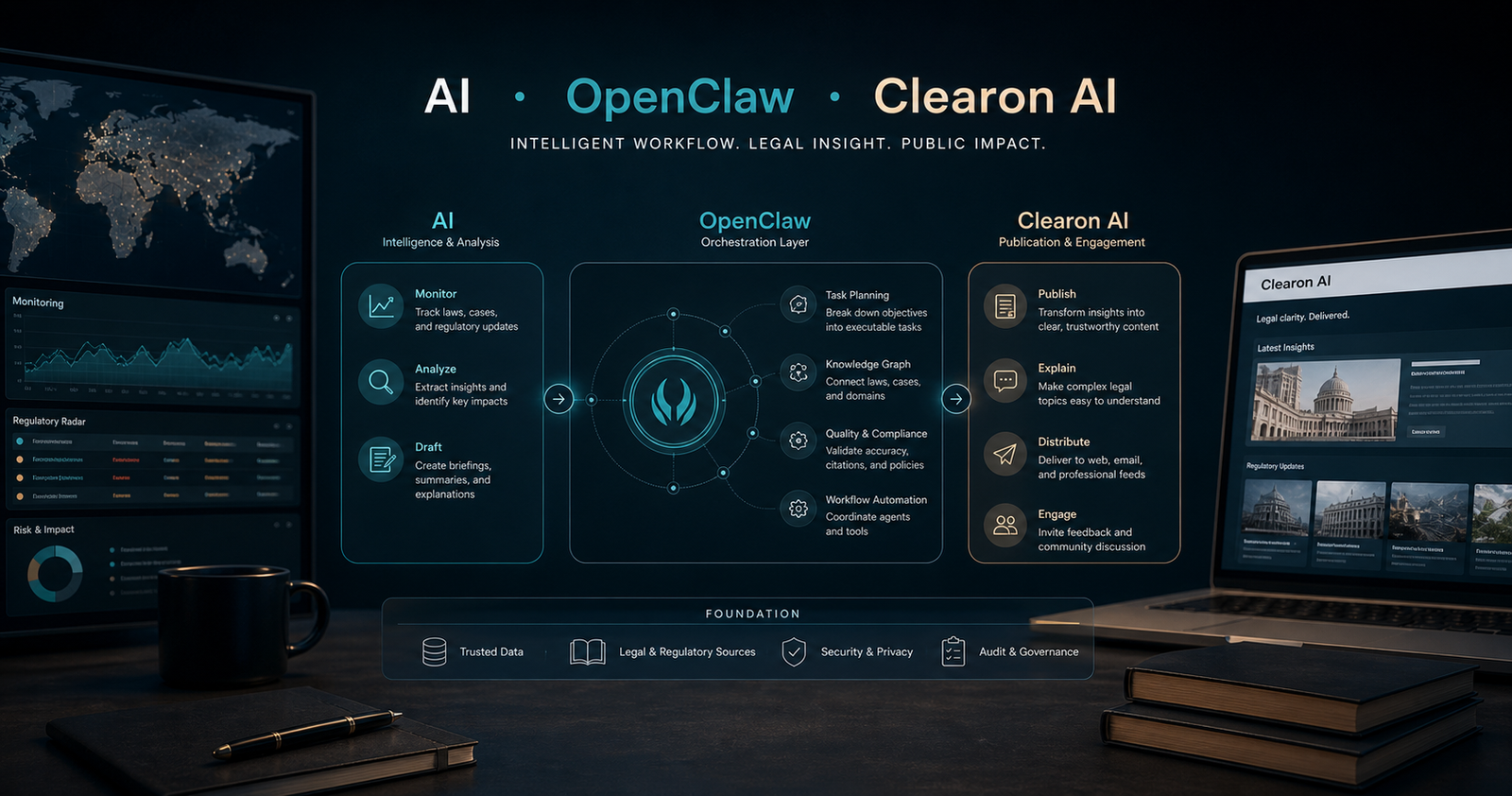
Most people experimenting with AI are still using it like a search engine with better grammar. I wanted to know whether it could do something more: monitor, organize, draft, publish, and improve over time without me babysitting every step.
I am also a bit of a geek about AI, so part of this was pure curiosity. But part of it was a real professional question: could an independent AI agent system actually be useful for legal and regulatory work?
That question led me to OpenClaw, a separate Mac Mini, a backup drive, and eventually a public website. Here is what I learned.
The First Question I Asked
Before building anything, I asked multiple AI agents the same question: what should I actually do with a system like this?
The answers were surprisingly consistent. Given my legal background, every agent pointed toward the same use case: monitor AI laws, regulations, litigation, court rules, and governance developments in a structured way.
That made immediate sense. AI legal and regulatory developments move fast, but not cleanly. A proposed bill is not a final rule. A regulator's speech is not binding law. A lawsuit is not a finding. A court order can be quietly significant long before anyone notices. That's exactly the kind of landscape where disciplined monitoring, source-checking, and follow-through matter, and where an AI agent, set up well, could genuinely help.
What started as a regulatory tracker quickly evolved. The system could identify patterns, surface article ideas, and support publishing, not just logging. The experiment stopped being a tracking exercise and started becoming an analysis and publishing workflow.
Why I Bought a Separate Mac Mini
Once I decided to take the experiment seriously, I did not want it living on the same machine as everything else in my life. So I bought a higher-end Mac Mini and dedicated it to this project.
I added an external drive for Time Machine backups and put the setup on a UPS so a power outage would not erase work in progress. The goal was to be able to experiment freely without feeling like one broken install was one step away from disaster.
I also wanted my personal information to stay personal and the experiment to stay contained. That separation mattered more than I expected. It made everything feel more intentional, and honestly, a lot easier to manage.
(Yes, I turned "let's try an AI agent" into a separate machine, a backup drive, and battery protection. That is also just who I am.)
Finding OpenClaw
As I explored different agent setups, OpenClaw stood out because it felt closer to a real operating environment than a demo. I was not looking for a flashy interface. I was looking for something that could connect tools, hold working context, manage drafts, communicate through Slack, and support repeatable workflows, not just one-off prompt tricks.
One early detail that helped: ChatGPT could walk me through the OpenClaw install step by step. That made the setup feel approachable rather than daunting. I got the system running faster than expected, and that early momentum mattered.
OpenClaw felt less like a toy and more like something I could actually work with. That distinction ended up being the whole ballgame.
Slack Was Useful. The Dashboard Was Better.
One of the first things I set up was a Slack integration so I could interact with the system from anywhere. That part worked well, and I still use it when I'm away from my desk or want to kick off a task quickly.
But I learned something simple pretty fast: when I am actually at the computer, the direct dashboard is better. It is easier to see context, follow multi-step work, review drafts, and manage more complex tasks. Slack is convenient. The dashboard is where real work gets done.
It also gives much easier access to draft files, introduces less delay, and makes the workflow feel more seamless. I spend less time wondering whether something crashed while I was waiting for a reply.
Early lesson: the communication surface you choose changes the quality of the workflow. That sounds obvious in hindsight. It was not at the start.
I Tried a Local Model First
My first instinct was to run a local model through Ollama. The appeal was obvious: more control, less dependence on a hosted provider, a cleaner sense of technical independence, and yes, free.
There was early success. It was exciting to see a local setup do real work. But once the system started failing in the middle of practical tasks, the question changed fast. I was not asking whether a local model was philosophically appealing anymore. I was asking whether it was reliable enough to support actual monitoring and drafting work. For me, at that stage, the answer was no.
So I switched to ChatGPT Plus, the basic $20 per month OpenAI plan. That was not a purity decision. It was a utility decision. Part of this experiment from day one was figuring out how cost-effective an AI agent workflow could be for real, sustained work.
I also learned early that there are different ways to engage the OpenAI layer, including ChatGPT Plus versus Codex-style token-based usage, and that distinction matters a lot for keeping costs manageable over time.
From Experiment to Project
Once the agent setup started becoming genuinely usable, the project expanded. I bought a domain. I subscribed to a hosting provider. I started building a place where the work could live publicly, not just inside a private experiment.
That changed everything. The question shifted from "Can I get an AI agent to help me?" to "Can I build a repeatable system that monitors AI law developments, publishes useful analysis, and improves over time without becoming absurdly expensive?"
That turned out to be a much better question. It forced real decisions about structure, sources, publishing cadence, categories, and review process. It turned AI from a novelty into an operating choice.
Three Things I Learned Early
- The value does not come from having access to AI. It comes from giving AI a job that fits your background, and then building the surrounding workflow carefully. For me, the right job was not generic content generation. It was structured monitoring of AI law and regulation, supported by drafting, organization, and publishing.
- Setup choices matter more than they appear. A separate machine mattered. A direct dashboard mattered. Slack mattered, but differently. Model reliability mattered more than I expected. And once I added a domain and hosting, the whole experiment became more concrete and more serious.
- AI agents get genuinely interesting once they move beyond conversation and into systems and workflows. That is the point where I stopped thinking mostly about prompts and started thinking about workflows, tools, monitoring, memory, publishing, and environment separation. That shift is where the real leverage shows up.
Why I'm Still Doing It
I am still early in this project, but the direction is much clearer than it was at the start. The experiment found its footing when it found the right use case: monitoring AI law, governance, regulation, and related news in a way that is structured enough to be genuinely useful, not just interesting.
In the next articles in this series, I will share what actually happened once the novelty wore off: what changed when I stopped treating the system like search, how the tracker evolved into a broader article pipeline, which workflows saved real time and which ones created cleanup, and where the cost and reliability challenges started showing up.
The experiment became much more interesting once it moved from setup into day-to-day use. That is the part worth writing about, and it is where the real lessons are.
If you are curious about where the AI law landscape is heading, or want to follow how this workflow evolves, the project lives at Clearon AI. That is where the tracker, the articles, and the ongoing analysis live.
You can also find the project at @Clearon_Ai on X and Clearon AI on LinkedIn.
Editorial Notes
Suggested dek: I didn't want a better chatbot. I wanted to know whether an AI agent system could monitor, organize, draft, publish, and improve over time for real legal and regulatory work.
Suggested social: I didn't want a better chatbot. I wanted to know whether an AI agent system could actually support legal and regulatory work over time. That question led me to OpenClaw, a separate Mac Mini, a failed local-model phase, ChatGPT Plus, and eventually a public site tracking AI law.
Leave a Reply