Washington Federal Court Sanctions Lawyer for AI-Hallucinated Citations — and Rejects the “I Didn’t Understand the Tool” Defense
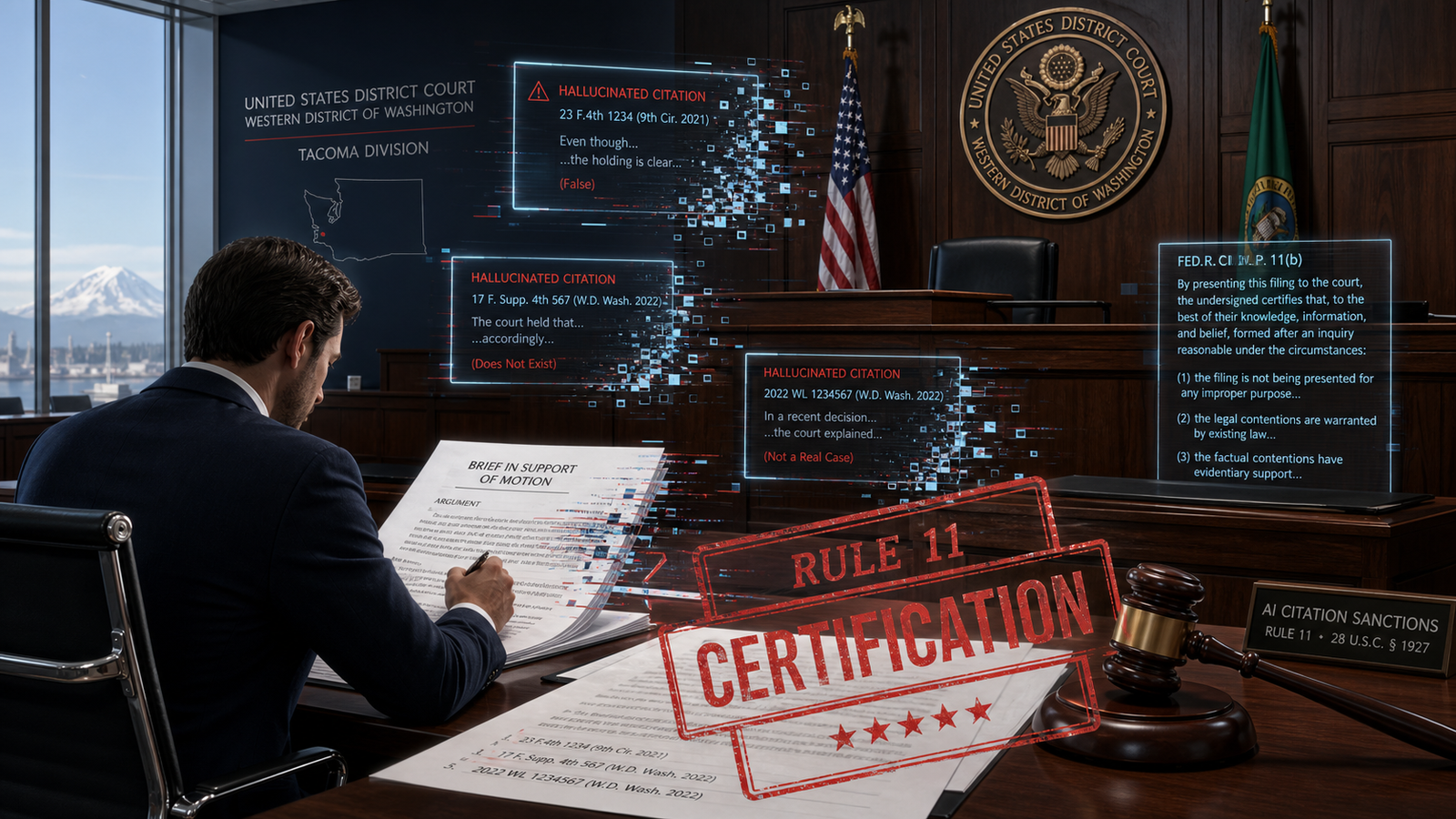
A federal judge in Tacoma has made clear that ignorance of how generative AI works is not a defense to sanctions. In Ledoux v. Outliers, Inc., No. 3:24-cv-05808-TMC (W.D. Wash. July 24, 2026), Judge Tiffany M. Cartwright sanctioned plaintiff’s counsel $3,000 under Federal Rule of Civil Procedure 11 after the lawyer submitted multiple filings containing dozens of hallucinated citations generated by ChatGPT and Claude.
The court was unmoved by the lawyer’s claim that she was unfamiliar with the tools and had placed “blind trust” in their output. The opinion noted that she failed to correct the errors even after opposing counsel flagged them, and that a later “corrected” filing still contained some of the original false citations.
The sanction and its conditions
Judge Cartwright imposed a $3,000 monetary sanction and ordered the lawyer to include a specific certification on all future filings in the case stating that she had independently verified every citation. The court explicitly tied the ruling to the lawyer’s duty of competence under RPC 1.1 and the WSBA’s Advisory Opinion 202505 on AI tools in law practice.
Why this case stands out
Most AI-citation sanctions to date have focused on the initial failure to verify. Ledoux adds two practical layers:
- The court treated the lawyer’s incomplete correction as an aggravating factor.
- It imposed an ongoing, case-specific verification requirement rather than a one-time penalty.
This moves the consequence from a monetary fine into a continuing procedural burden — something firms should factor into risk assessments when lawyers use generative AI for court filings.
Practical implications
Lawyers who use generative AI for research or drafting must verify every citation themselves. Claims that the lawyer “didn’t know the tool could hallucinate” are unlikely to be persuasive. Courts are increasingly willing to impose both financial sanctions and forward-looking certification requirements on counsel who fail to meet this standard.
This article summarizes a published sanctions order. It does not constitute legal advice.
Sources
- Ledoux v. Outliers, Inc., 2026 WL 2137370 (W.D. Wash. July 24, 2026)
- NWSidebar (Aug. 10, 2026)
- WSBA Advisory Opinion 202505
Leave a Reply