
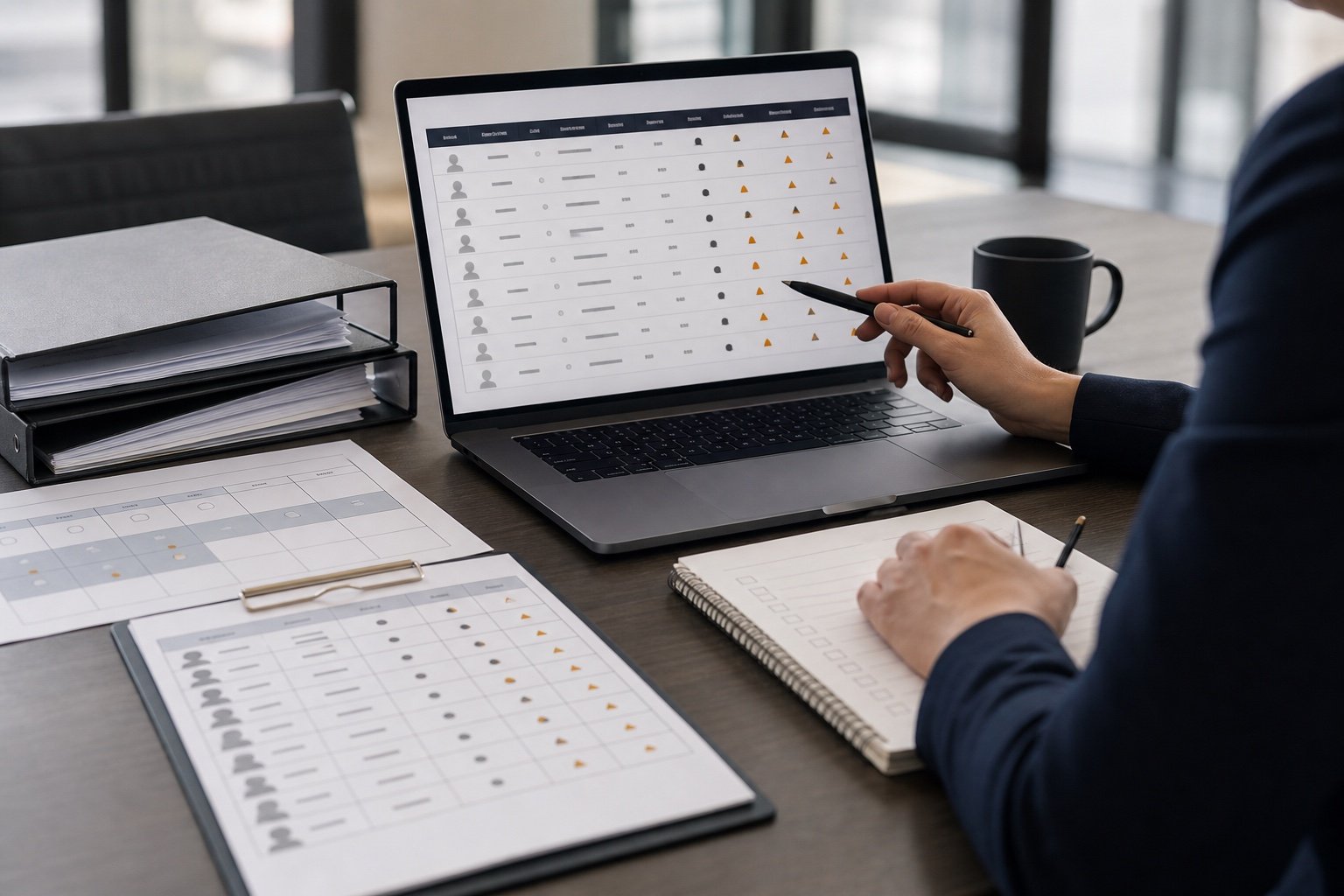
A new lawsuit against Meta asks a question many employers have managed to postpone: what happens when employees say AI helped decide who lost a job, while the employer says humans made the decisions without AI scoring or ranking?
Twenty-six current and former Meta employees allege that the company used internal AI systems, activity-monitoring data, productivity measures, AI-token consumption, and algorithmically assisted rankings to select workers for a May 2026 reduction in force. The plaintiffs say the process penalized employees who had taken protected medical, parental, pregnancy-related, caregiver, or family leave.
Meta denies using AI to make the selections. In a declaration filed with the court, a Meta human-resources director said human business leaders made the decisions using documented criteria and that there was no AI-assisted scoring or ranking related to employee performance.
The case is Does 1 Through 26 v. Meta Platforms, Inc., No. 3:26-cv-07122-WHO, filed July 13 in the Northern District of California. The court has denied the employees' request for a temporary restraining order, but it did not resolve the underlying claims. U.S. District Judge William Orrick found "serious questions going to the merits" and said discovery in arbitration would be needed to test Meta's account.
That dispute is what makes the case useful. It shows the evidentiary problem employers will increasingly face when workforce decisions sit near performance systems, activity data, AI tools, dashboards, and human approvals. The central issue may be less about one identifiable algorithm than whether the employer can prove what did and did not affect the result.
What The Employees Allege
The complaint says Meta began notifying about ten percent of its workforce on May 20 that they had been selected for termination.
According to the plaintiffs, managers who knew the employees' work did not assemble the termination list through individualized judgment. They allege that Meta used a group of internal tools and data sources that included:
- "Metamate," described as an internal large-language-model assistant;
- employee-trained "second brain" agents that ingested communications and work documents;
- keystroke, screen-content, mouse, browser-history, and other activity data;
- dashboards showing employee-level AI-token consumption;
- productivity, output, performance, and calibration measures; and
- algorithmically assisted rankings, including what the complaint calls an "AI-native" rating.
Those details are allegations, not established findings. They still illustrate why a modern workforce case may be hard to explain through a conventional account of one supervisor making one decision.
The plaintiffs' central theory is that the system rewarded signals employees could accumulate only while actively working. Someone on protected leave could not generate code commits, output volume, AI-tool usage, roadmap ownership, or similar measures at the same rate as an employee who was present throughout the measurement period.
The complaint alleges that Meta failed to neutralize protected-leave periods, remove affected employees from the comparison group, or require an individualized review that accounted for leave and accommodations. The employees claim those omissions turned apparently neutral productivity signals into negative factors tied to protected activity or disability.
The complaint brings claims under federal and state employment laws, including the Family and Medical Leave Act, the Americans with Disabilities Act, the Pregnancy Discrimination Act, and the Pregnant Workers Fairness Act. It also invokes laws in several states and the District of Columbia.
What The Court Has Said So Far
The July 17 temporary-restraining-order decision gives both sides something to point to.
Meta submitted a declaration stating that human business leaders made the selections using criteria such as job profile, level, historical and recent performance ratings, tenure, location, job function, specialized skills, and organizational structure. The declaration said no plaintiff was selected because of leave, disability, or another protected characteristic and that AI made no selection decision.
The employees submitted declarations describing their understanding of Meta's growing use of AI in performance reviews and internal employee classifications. But the judge noted that they were not present when the reduction-in-force decisions were made and did not yet have evidence rebutting Meta's direct account.
Judge Orrick found that the employees had raised serious questions but had not shown a likelihood of success on the existing record. He denied emergency relief largely because most claimed harms, including lost employment, benefits, leave, and equity, could be addressed through damages or relief in arbitration.
The order did identify a narrower concern. Four plaintiffs held Meta-sponsored employment visas, and the judge said the potential loss of immigration status likely could constitute irreparable harm. He directed Meta to submit declarations explaining how and why those four employees were selected. The preliminary-injunction hearing is scheduled for August 24.
The order did not decide whether Meta used AI improperly or violated employment law. It framed the proof question: the employees suspect that AI-related systems affected the result; Meta says they did not; and the relevant records are largely controlled by Meta.
The Hard Question Is How The Decision Was Made
Companies often describe AI as advisory. A manager still approves the result, so the company may believe that a human remains responsible for the decision.
That description does not resolve the legal or factual problem.
If an algorithm determines which employees receive scrutiny, converts workplace activity into a score, sets a comparative ranking, or supplies the recommended list, the later human approval may carry less weight than the company assumes. The quality of the human review matters more than the existence of a final click.
An employer defending this kind of case may need to show:
- what systems and data affected the decision;
- which metrics were calculated and over what period;
- how leave, disability accommodations, and missing data were treated;
- whether managers could change a recommendation;
- what information managers saw before approving it;
- how often managers overrode the system; and
- whether anyone tested the process for distorted or discriminatory results.
A human signature at the end of the process does not answer those questions.
Measurement Windows Can Become Legal Risk
The complaint focuses attention on a basic design choice: the measurement window.
A productivity system can appear neutral while treating absence as poor performance. That risk grows when the system relies on volume measures such as messages sent, code committed, documents produced, hours active, or AI tokens consumed.
The problem is not limited to formal leave. Disability accommodations may change how or when an employee works. Pregnancy-related restrictions may reduce certain kinds of activity. Caregiving leave can create gaps that a ranking system reads as lower output. A system trained on uninterrupted work histories may treat legally protected circumstances as performance signals unless the employer deliberately changes the design.
Governance teams should therefore ask a more precise question than whether a model uses protected characteristics. They should ask whether the system uses proxies or measurement rules that systematically encode the effects of protected leave, disability, pregnancy, or accommodation.
Employers Need A Decision Record, Not Just An AI Policy
Most AI policies say that people must remain involved in consequential decisions. That is a useful principle, but it is not a litigation record.
For workforce decisions, employers need documentation tied to the actual event. A defensible record should identify the system version, input fields, relevant dates, scoring logic, exclusions, adjustments, reviewers, overrides, and final reasons for each decision.
That record should also explain how the employer handled protected leave and accommodations. If a measurement period overlapped with leave, the company should be able to show whether it adjusted the denominator, removed the affected period, used a different comparison, or excluded the metric.
The same principle applies to vendors. A company may use a third-party model, but the employment decision remains the company's. Contract language should provide access to the documentation, testing information, logs, and technical support needed to investigate a challenged result.
Discovery Will Reach Beyond The Final Layoff Spreadsheet
The complaint also shows how quickly an employment dispute can become an AI-governance and data-preservation matter.
Relevant evidence may include:
- prompts and outputs from internal assistants;
- model and scoring documentation;
- employee-level dashboards;
- activity-monitoring records;
- calibration materials;
- communications about metric selection;
- bias, validation, and impact testing;
- manager instructions and override records; and
- records showing when employees requested leave or accommodations.
Legal holds written for ordinary personnel files may miss much of that material. Some records may sit in analytics platforms, model logs, collaboration systems, or vendor environments with short retention periods.
Employment counsel, privacy teams, and technical owners should decide in advance who can preserve those records and how quickly preservation can begin.
What Companies Should Review Now
Employers do not need to wait for a ruling in the Meta case to examine their own processes.
Start with an inventory of every system that can affect selection for promotion, discipline, performance management, restructuring, or termination. Include systems described internally as analytics, productivity, workflow, or decision support. Labels do not determine whether a tool influences an employment decision.
Then map the inputs. Look specifically for measures that fall when an employee is absent or working under an accommodation. Test whether protected leave changes an employee's score, rank, comparison group, or likelihood of additional review.
Finally, inspect the human-review step. Reviewers need enough information and authority to identify a distorted recommendation. A process that asks a manager to approve hundreds of names without explaining the underlying data is not meaningful review.
The Larger Lesson
The Meta lawsuit may succeed, fail, or narrow as the employees pursue their claims in arbitration. Their allegations have not been proven, and Meta has submitted a direct factual denial.
The governance problem exists either way. Employers are combining workplace monitoring, productivity analytics, internal AI assistants, performance ratings, and ranking systems. When those systems affect a termination decision, the company needs to reconstruct the path from raw data to final outcome.
If AI helps build the layoff list, an employer should be ready to show what the system measured, what it ignored, who reviewed the result, and how legally protected circumstances were kept from becoming negative signals.
Without that record, "a human made the final decision" may be a conclusion the evidence cannot support.
Leave a Reply