
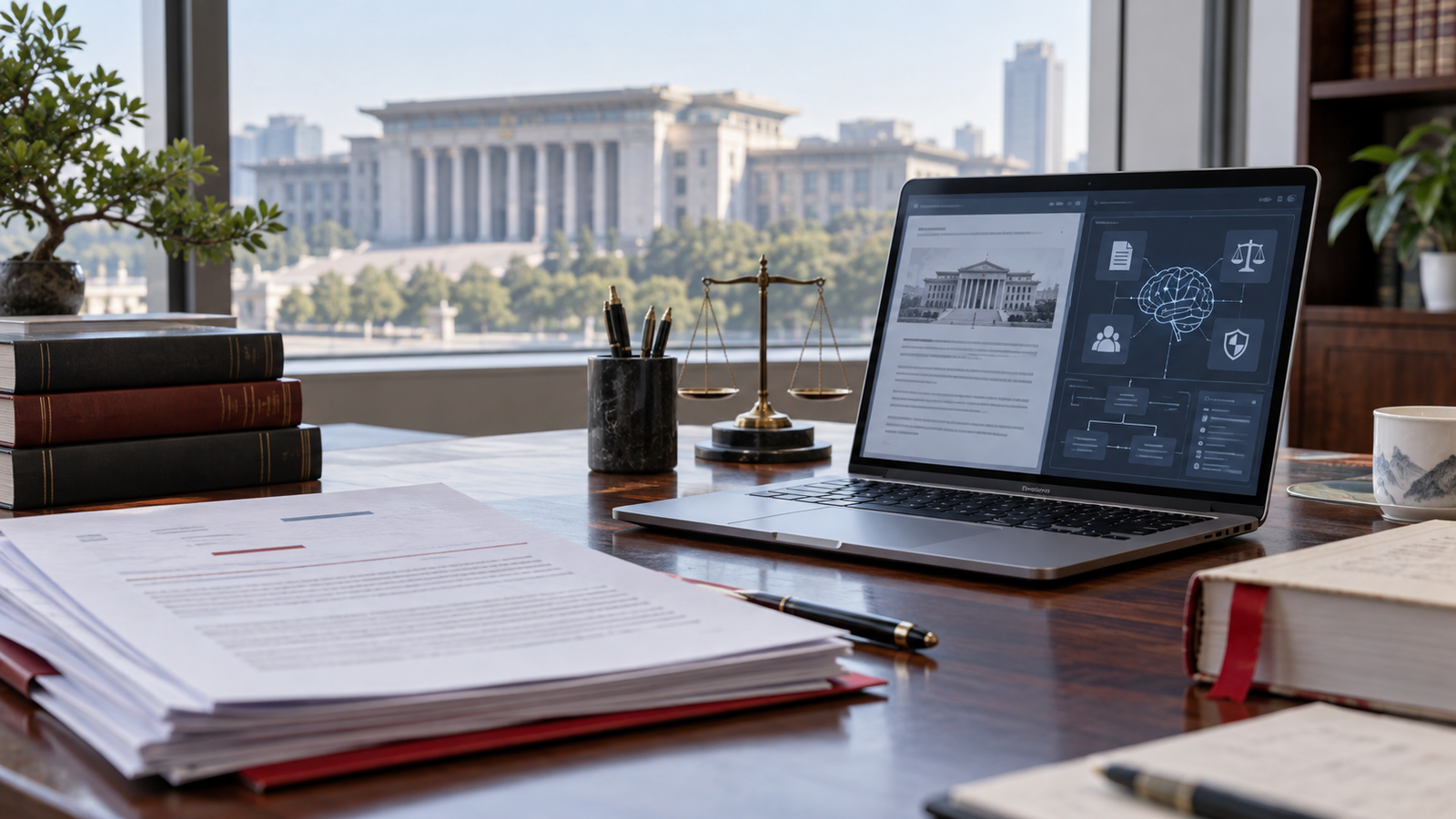
China's Top Court Turns AI Disputes Into Litigation Rules
China's Supreme People's Court has moved AI governance from policy abstraction into courtroom administration.
On September 7, 2026, the court released Opinions on lawfully hearing AI-related dispute cases. The court described the document as the first AI-related judicial adjudication-rule document issued by a national highest court. It has five parts and 24 articles, and it directs Chinese courts on how to approach AI disputes under existing law.
That distinction matters. The Opinions are not a standalone national AI statute. They do not create a single licensing regime for AI systems, and the court's own materials say China has not yet enacted a specialized AI law. Instead, the Opinions use existing legal frameworks, including civil, cybersecurity, data security, copyright, anti-unfair-competition, consumer-protection, personal-information, and civil-procedure laws, to give courts a working map for AI litigation.
For companies, that may be more important than it sounds. A statute tells the market what the legislature has commanded. A top-court adjudication document tells litigants how disputes are likely to be framed when something goes wrong.
The practical message is direct: companies operating AI systems in or connected to China should expect judges to ask who controlled the system, what risks were foreseeable, what safeguards were used, what evidence can be produced, and whether AI-assisted filings or outputs were verified before they reached a court, consumer, user, or counterparty.
What The Opinions Cover
The Opinions are broad. They do not focus only on one fashionable AI problem, such as hallucinated legal citations or deepfakes. They organize AI disputes across several recurring litigation categories.
First, they address tort liability for AI-related harm. The court says liability should be assessed under existing laws, and that fault should generally be the baseline where no statute imposes strict liability or presumed fault. In judging fault, courts are told to consider the AI application's context, degree of autonomy, transparency of technology and information, risk level, risk-reduction measures, and the user's ability to foresee and control the harmful conduct.
That is an important governance signal. The inquiry is not just "did the model cause harm?" It is also whether the developer, provider, user, seller, or other actor had a practical ability to understand and reduce the risk.
Second, the Opinions cover personality rights and privacy. They address AI face-swapping, voice cloning, digital resurrection of deceased people, doxxing, human search, and AI-enabled invasions of privacy. The court's Q&A emphasizes that the document is meant to protect name, likeness, reputation, privacy, voice, and related personality interests while still allowing lawful innovation.
Third, the Opinions address generative-AI service-provider responsibility. The court's materials describe a notice-and-action structure for some AI-generated personality-rights harms: if generative AI automatically creates content that infringes reputation or privacy interests, and the rightsholder gives a proper notice, the service provider may face liability if it does not take necessary measures in time. The court also addresses users who intentionally induce infringing AI outputs through prompts.
This is not a simple "platforms always liable" rule. It is closer to a governance question about knowledge, notice, control, and response. The Q&A explains that generative-AI providers may have a basis to rely on a notice-removal style approach because they cannot predict every user prompt or generated output in advance, but that protection is not a license to ignore obvious or notified harms.
Fourth, the Opinions address consumer and product disputes. They include algorithmic price discrimination, fake celebrity endorsements, AI product liability, autonomous-driving and driver-assistance accidents, and the evidentiary role of vehicle or system data. For physical AI products, courts are told to look at defects, use scenarios, warnings, system limitations, updates, user control, and applicable standards. For automated or assisted driving accidents, courts may require manufacturers, sellers, operators, or data controllers to provide truthful and complete event records where needed to determine the facts.
Fifth, the Opinions address AI intellectual property disputes. They discuss AI-generated content, open-source software, patent eligibility and inventorship, technology contracts, data sets, trade secrets, unfair competition, and attacks on AI operational security through techniques such as malicious labeling or adversarial examples.
Finally, they address procedure. Courts are directed to improve fact-finding and evidence review in AI-related cases, use technical expertise where needed, and sanction AI-assisted misconduct in litigation. The Opinions specifically state that litigation participants who use AI to generate pleadings, case-search reports, or other submitted materials should verify their truth and accuracy before submission, disclose AI assistance to the court, and bear responsibility for the content.
That last piece should sound familiar to lawyers outside China. It is the same institutional anxiety appearing in U.S. courts, where AI tools have created fake-citation problems, judicial-process questions, and new pressure to document human review. Clearon recently covered a U.S. appellate example involving judicial AI use and reassignment questions. The China Opinions show that the courtroom-governance problem is not local.
The IP Piece Is Carefully Limited
The most commercially important part may be the IP section, but the court is careful about what it does and does not decide.
The Opinions say that when AI-generated content allegedly infringes copyright, courts should consider the type of AI service, industry characteristics, training-data sources, each party's participation, necessary measures taken, and profit. The Q&A adds that a party should not escape responsibility merely because the challenged content was generated by AI. Responsibility should be tied to control, duty of care, role in the generation process, training data, preventive measures, and economic benefit.
The Opinions also address evidence. A claimant alleging that an AI developer or provider infringed copyright must make a preliminary showing that the challenged content was AI-generated and substantially similar to the claimant's work. But if the developer raises a non-infringement defense, courts may require evidence about training-data sources, training process records, model operating modes, and scientific or theoretical bases where necessary.
That is a serious litigation-design issue for AI companies. It means that documentation around training data, model operation, filtering, and deployment cannot be treated only as internal engineering history. It may become litigation evidence.
At the same time, the court leaves two contested issues unresolved. The Q&A says the Opinions do not decide copyrightability of AI-generated content or the legal characterization of using others' works to train large models, because views remain divided and further experience is needed.
That restraint is important. It means companies should not read the Opinions as a final answer to every China AI copyright question. The better reading is that the court is building a litigation framework first: responsibility, evidence, duties, and dispute handling, with some harder substantive questions reserved for later cases or rules.
Technology Is Not An Exemption Card
One of the court's strongest themes is that AI technology does not erase responsibility.
The Supreme People's Court's accompanying analysis says technology is not an "exemption card." That framing is not a statutory test, but it captures the practical posture of the Opinions. Courts are being told to look past generic statements that AI is autonomous, unpredictable, or technically complex, and instead ask what the relevant actor could know, prevent, verify, explain, or control.
That matters across the whole document.
For generative-AI providers, the question becomes whether the provider had notice of infringing content and whether it took necessary measures. The accompanying analysis also discusses the red-flag principle under existing Civil Code rules, while acknowledging that the Opinions do not create a standalone red-flag provision. For users, the question becomes whether the user intentionally induced harmful output or knew of a prior work and used AI to generate substantially similar content without a valid defense. For product sellers and manufacturers, the question becomes whether warnings, usage limits, system data, and foreseeable risks were handled accurately. For litigants and lawyers, the question becomes whether AI-generated submissions were verified and disclosed.
This is the governance lesson: in AI disputes, courts may not be satisfied with broad product descriptions. They may want records.
Companies should be ready to explain how the system was designed, what warnings were given, what safeguards were available, how outputs were monitored, what contractual limits applied, what logs exist, how user reports and notices were handled, and who made escalation decisions.
The Courtroom-Use Rule Is A Compliance Signal
The litigation-materials rule is one of the clearest parts of the Opinions.
The court says litigation participants who submit pleadings, case-search reports, or other materials generated with AI should carefully verify the truth and accuracy of relevant laws, judicial interpretations, cases, and other content before submitting them. They should also explain the AI assistance to the court and bear responsibility for authenticity and accuracy.
That is not just a courtroom etiquette point. It is a compliance signal for law firms, in-house litigation teams, expert witnesses, and vendors that sell legal AI tools.
A legal AI workflow that cannot show who checked the output, what source was reviewed, and what changed before filing is going to be weak under this kind of rule. The same problem appears in U.S. practice: courts are not usually interested in whether a lawyer used a fashionable tool. They are interested in whether the lawyer verified what was filed.
For companies, this means AI use policies should distinguish between ordinary drafting assistance and materials that become evidence, legal argument, expert work, regulatory submissions, customer notices, or public commitments. The higher the consequence, the stronger the source-control and human-review record should be.
What Companies Should Do Now
The Opinions are formally about Chinese courts, but they are useful beyond China because they show how judges may organize AI disputes.
First, map AI risk by dispute category, not only by product category. A single AI system can produce privacy claims, consumer claims, IP claims, product-liability questions, contract disputes, evidence issues, and unfair-competition allegations. Legal teams should know which parts of the product create which litigation records.
Second, preserve system and data documentation that may become evidence. Training-data provenance, model-operation records, filtering decisions, prompt logs, output histories, user notices, complaint records, takedown steps, and human-review records can all become important. The point is not to hoard data without limits. It is to align retention, privacy, and litigation-readiness before a dispute starts.
Third, update notice-and-response workflows for AI-generated harms. If a user reports an AI-generated impersonation, voice clone, defamatory output, privacy invasion, or infringing generation, the company should have a defensible triage path. That path should record what notice was received, whether it was complete, what content or prompt was involved, what measure was taken, and when.
Fourth, review AI product warnings and marketing. The Opinions tie responsibility to use scenarios, system limitations, foreseeable risks, and whether users were accurately informed. Overstating autonomy, reliability, or safety can create downstream litigation risk.
Fifth, separate AI-assisted legal work from ordinary productivity use. Litigation materials, case-search reports, evidence summaries, and expert materials need verification and disclosure controls. A legal department can allow AI assistance and still require source validation before anything is submitted.
Finally, avoid treating unresolved questions as settled. The court deliberately left AI-generated-content copyrightability and training-data legality open. That leaves room for future cases, regulations, or guidance. Companies should keep legal positions flexible and source-bound rather than building policies around overconfident predictions.
The Takeaway
China's Supreme People's Court has not solved every AI law question. It has done something more operational: it has told courts how to begin hearing AI disputes.
The Opinions organize AI litigation around responsibility, control, evidence, verification, notice, product warnings, data use, IP documentation, and courtroom integrity. That is the practical center of AI governance. The hard questions are not limited to whether an AI system is powerful. They include who controlled it, who benefited from it, who could foresee harm, who received notice, what records exist, and whether humans verified the legally consequential output.
For companies, the lesson is not to treat China as a silo. The themes in the Opinions match broader global pressure: courts and regulators increasingly expect AI governance to be explainable in records, workflows, controls, and human accountability.
The companies best positioned for this environment will not be the ones with the longest AI policy. They will be the ones that can prove, in a dispute, how their systems were governed before the dispute arrived.
Leave a Reply