Selected US State AI Election Law Comparison: A Working Memo on Enacted Laws, Disclaimers, Satire, and Litigation
This is a selected-state comparison memo, not a final 50-state survey.
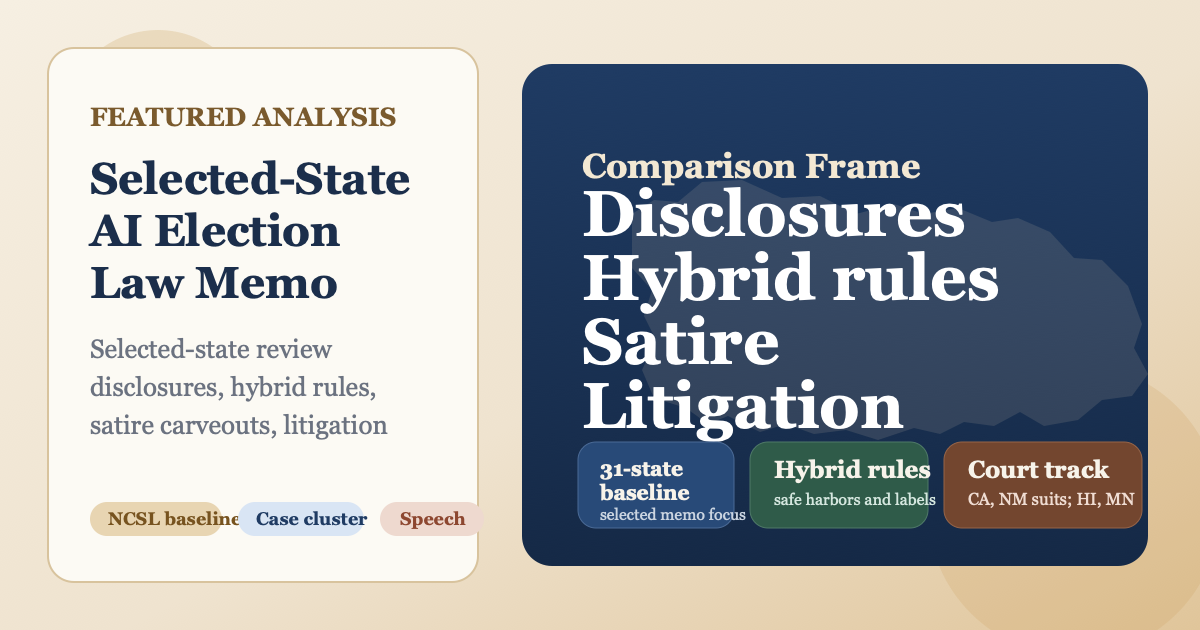
As of June 23, 2026, the National Conference of State Legislatures said 31 states had enacted some form of election-related AI or synthetic-media law. That NCSL count is the baseline. This article reviews a smaller enacted subset closely enough to compare the main statutory models and the litigation issues now surfacing in the New Mexico, California, Hawaii, and Minnesota disputes.
That distinction matters. The article is meant to clarify the main models in the field, not to claim that only a handful of states have acted.
1. Start with enacted laws, not just litigated laws
The enacted-law field is broader than the states already in court.
From the materials verified for this memo, the enacted set clearly includes at least Alabama, Arizona, California, Colorado, Florida, Hawaii, Idaho, Indiana, Mississippi, New Mexico, New York, Oregon, Utah, and Wisconsin, alongside other states included in the NCSL total.
That means New Mexico is not operating in a narrow outlier group. It is part of a substantial and still-growing state-law field.
2. One common model is disclosure
Under the disclosure model, a state permits election-related synthetic media at least in some circumstances but requires the speaker to add a warning or disclosure. The trigger often turns on timing, medium, or whether the content depicts a candidate or ballot issue.
The directly verified examples reviewed for this memo include:
- Colorado: candidate-election deepfake disclosures with enforcement and private-cause-of-action features.
- Florida: disclaimers for certain political advertisements, electioneering communications, and related ads that use AI.
- Indiana: disclaimer requirement when campaign communication includes fabricated media depicting a candidate.
- New York: political communications using materially deceptive media must carry the statute's disclosure language.
- Oregon: campaign communications using synthetic media must say the content has been manipulated.
- Utah: synthetic audio and visual election communications must carry prescribed words.
- Wisconsin: AI-generated audio or video political ads require disclosure.
Some statutes sit near the line because they use prohibition language while also tying lawful distribution or exceptions from liability to disclosure mechanics. That overlap matters because it shows why simple labels can hide meaningful structural differences.
3. Another model is prohibition plus disclosure or safe harbor
A second model uses prohibition language aimed at deceptive or materially deceptive election media, often with a disclosure safe harbor or adjacent exception. These are not pure bans in the ordinary sense. They are hybrid statutes.
The verified examples reviewed for this memo include:
- Alabama: makes certain materially deceptive election communications criminal when distributed to influence an election, subject to statutory exceptions.
- Arizona: bars deceptive synthetic media close to an election unless the required disclosure is included.
- Hawaii: reaches reckless distribution of materially deceptive media in candidate elections, subject to listed exclusions and defenses.
- New Mexico: uses a ninety-day rule tied to knowledge, intent to mislead voters, and likelihood of that result, with a disclaimer safe harbor.
This is where precision matters for New Mexico. Section 1-19-26.8 is the ninety-day prohibition provision. The Bee's complaint, however, principally challenges the separate year-round advertisement-disclaimer provisions in Section 1-19-26.4.
4. Satire and parody are the real fault line
Satire and parody are the hardest comparison point because state laws handle them in very different ways.
The safest framework is to separate three possibilities:
- Express carveout: the statute excludes satire or parody from the operative restriction.
- Conditional carveout: the statute mentions satire or parody but still conditions lawful use on a disclaimer or other required treatment.
- No clear carveout: the statute does not clearly spare satire or parody, or the exception is too uncertain to summarize confidently from the available text.
Arizona belongs in the express-carveout bucket. Colorado, New York, and Oregon also use express satire/parody exclusions in the enacted measures cited for this memo.
California should not be treated as a single blended model. Enacted AB 2655 contains an express satire/parody exemption, while enacted AB 2839 uses a disclosure-conditioned exception that still ties lawful use to label mechanics.
New Mexico fits the conditional-carveout bucket for purposes of the Bee's complaint because the Bee argues the statute does not truly exempt satire and parody from the challenged ad-disclaimer rule.
Hawaii is different again. In The Babylon Bee v. Lopez, the district court concluded the law lacked an explicit or implicit satire/parody exception sufficient to save it.
That is why Arizona, California, Hawaii, and New Mexico are useful comparison points. They do not use the same carveout model.
5. The litigation cluster still centers on four states
As of August 12, 2026, the clearest litigation cluster remains:
- California: AB 2839 and related AB 2655 litigation, with district-court summary-judgment and permanent-injunction relief on key claims and an active Ninth Circuit appeal.
- Hawaii: Act 191 / S 2687, where the district court entered a permanent injunction and the case later closed without an appeal after a fee settlement.
- Minnesota: Minn. Stat. § 609.771, where the district court denied preliminary relief and the Eighth Circuit affirmed that denial without reaching the constitutional merits, relying on standing and delay.
- New Mexico: HB 182, with the Bee's complaint filed on August 11, 2026.
Litigation status is useful, but it is not a complete proxy for statutory strength. Some laws remain untested because no plaintiff has brought the right case yet.
Working takeaways
Several points are already clear.
First, election-related AI laws are now common enough that New Mexico cannot be treated as a one-off.
Second, the most important split is not disclosure versus prohibition in the abstract. Many states combine both techniques.
Third, the key pressure point in the Bee cases is how a statute treats satire and parody. That is where Arizona, California, Hawaii, and New Mexico become especially useful comparison states.
Fourth, New Mexico's lawsuit should be described carefully. The Bee is not challenging every moving part of HB 182. The complaint is aimed mainly at the year-round advertisement-disclaimer regime, while the statute separately contains a ninety-day prohibition rule.
Bottom line
New Mexico sits inside a larger and still-growing state-law field, even if this article only closely reviews a selected subset.
The most useful comparison question for the current litigation is narrower than a full 50-state inventory. It is whether courts will treat required AI warnings on political satire as a permissible election safeguard or as an unconstitutional burden on protected speech.
This article is a selected-state comparison memo based on enacted statutes and current litigation materials. It does not provide legal advice.
Leave a Reply