Babylon Bee v. Bonta Shows Why California's Election AI Laws Cannot Be Treated as One Thing
California is still the most useful comparison state for the New Mexico Babylon Bee case. But it only helps if it is described carefully.
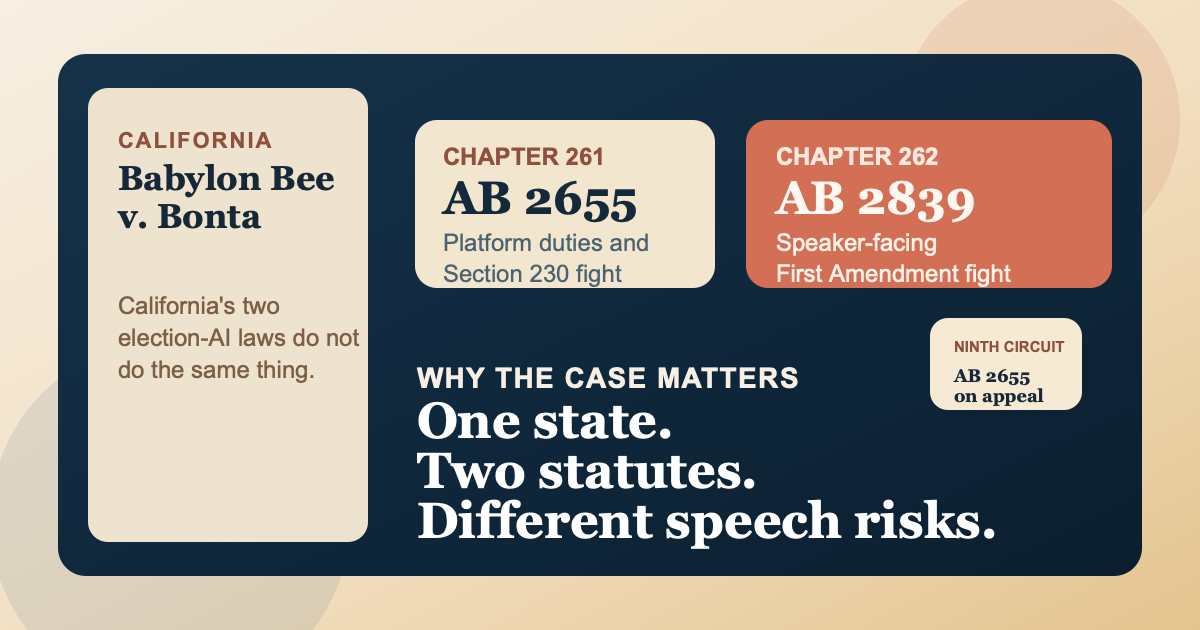
Too much commentary treats California's election-AI fight as though one law did all the work. That is not the cleanest way to understand the dispute. California enacted two related 2024 measures, and they do not handle platform duties, satire, parody, and compelled treatment of election content in the same way.
That distinction matters because Babylon Bee v. Bonta is not just a story about whether California may regulate deceptive election media. It is also a story about how statutory design changes the constitutional analysis.
California enacted two different measures
The relevant California measures are AB 2655 and AB 2839.
AB 2655, chaptered as Chapter 261 on September 17, 2024, added Elections Code provisions beginning at Section 20510 under the "Defending Democracy from Deepfake Deception Act of 2024" and took effect on January 1, 2025.
AB 2839, chaptered the same day as Chapter 262, added Elections Code Section 20012 and took effect immediately as an urgency measure. Its legislative topic line is "Elections: deceptive media in advertisements."
That is the first point lawyers should keep straight. California did not enact one broad election-AI law. It enacted at least two separate measures in the same policy lane, with different structures and different constitutional pressure points.
The litigation split mattered too
The Bee plaintiffs sought immediate preliminary relief against AB 2839 in October 2024. California officials later agreed the statute could not be enforced against ADF's clients after the court in Kohls v. Bonta concluded it likely violated the First Amendment.
The bigger district-court turning points came in August 2025, and they were not the same ruling.
On August 20, 2025, the court entered final judgment and a permanent injunction as applied to X and Rumble as to AB 2655 on Section 230 preemption grounds. A later stipulation and order extended non-enforcement protection to other providers of interactive computer services, unless that judgment is vacated on appeal.
On August 29, 2025, the court granted summary judgment and permanently enjoined enforcement of AB 2839 against the named plaintiffs on First Amendment grounds.
That distinction matters because AB 2655 did not fall on a single broad holding that every part of it was unconstitutional. The platform-duty regime was treated as preempted by the Communications Decency Act, while the AB 2839 ruling squarely addressed the First Amendment.
Why the statutory split matters
California is a bad comparison state if it is used sloppily.
AB 2655 is the platform-duty statute in the California pair, even though it also contains an express satire/parody exemption. AB 2839 is the more direct speaker-and-distributor statute, and its treatment of satire and parody still turns on disclosure mechanics.
That difference matters because a court may respond differently to a large-platform removal and labeling regime than to a law that directly regulates political speakers and distributors.
California's litigation value is not just that "California lost." Its value is that the case shows how much constitutional weight can turn on the exact way a legislature writes a synthetic-media rule.
Why California still matters for New Mexico
New Mexico's case is narrower than the full California fight, but California remains the nearest high-profile comparison.
The Bee's New Mexico complaint is mainly aimed at the year-round advertisement-disclaimer regime in HB 182, not every part of the statute's separate ninety-day prohibition structure. That makes California especially relevant because California's dispute also placed heavy pressure on election-related speech rules touching political memes, parody, and compelled treatment of synthetic media.
California therefore supplies at least three useful questions for New Mexico:
- How closely will a court read the exact statutory text instead of the state's general anti-deception rationale?
- Will the court treat satire and parody as clearly protected in practice, not just in theory?
- When a law forces labels, removals, or other compelled treatment of political content, how much tailoring is enough?
What California does not prove
California should not be overstated.
The district-court result does not automatically decide what happens in New Mexico or elsewhere. California sits in the Ninth Circuit. New Mexico sits in the Tenth. The statutes are not identical, and neither is the procedural posture.
California also does not prove that every election-related AI disclosure statute is unconstitutional. What it shows is narrower and more useful: courts can treat these laws as serious burdens when they impose platform duties, compelled labels, or other direct treatment of political satire and parody.
Bottom line
Babylon Bee v. Bonta matters because California's election-AI laws cannot be analyzed as one undifferentiated package.
The state enacted AB 2655 and AB 2839 as separate measures. The litigation then turned California into the clearest live example of how statutory design, platform duties, satire treatment, and compelled-speech problems can collide in this area.
For lawyers watching New Mexico and other state election-AI fights, California is still the comparison state that deserves the closest reading. It just should not be flattened into a one-law story.
This article summarizes enacted California measures and related litigation materials. It does not provide legal advice.
Leave a Reply