
Gene Quinn's new IPWatchdog Unleashed article recounts his conversation with Bijou Mgbojikwe, senior policy counsel at the Entertainment Software Association, about a central scoping problem: laws aimed at harmful deepfakes can sweep together licensed digital replicas, fictional game content, and other materially different uses. Their discussion deserves direct attention, and Clearon's tracker shows why.
Full credit to IPWatchdog, Gene Quinn, and Bijou Mgbojikwe. The article is worth reading in full, and the related podcast and YouTube versions are worth watching or listening to as well.
The core point is simple and important. Lawmakers often talk about deepfakes, digital replicas, AI disclosures, and harmful deception as though they were one problem with one obvious fix. They are not.
That matters because Clearon's tracker already shows several different regulatory models moving at once. Some are relatively narrow and tied to a concrete harm. Others use broader synthetic-media or deception concepts that become much harder to apply cleanly once they reach expressive content, fictional environments, or ordinary digital creativity.
The IPWatchdog Point Deserves Serious Attention
Gene Quinn's writeup of his conversation with Bijou Mgbojikwe frames the issue more carefully than much of the broader AI-regulation commentary does.
The concern is not that lawmakers should ignore fraud, impersonation, child safety, or deceptive synthetic media. The concern is that a rule designed for one misuse case can spill outward if it defines the covered content too broadly or treats every realistic AI-generated output as though it presents the same risk.
That is especially important for games and other expressive media. A law aimed at deceptive political media, nonconsensual sexual deepfakes, or misleading advertisements does not necessarily fit a fictional game world, a synthetic background character, a stylized voice clone used with rights clearance, or a digital replica embedded in a licensed creative work.
Our Tracker Already Shows At Least Three Different Regulatory Models
The current watchlist and published tracker notes show why this should not be treated as a single undifferentiated "AI content" category. The laws we track already fall into materially different buckets.
1. Narrower disclosure rules tied to a specific context
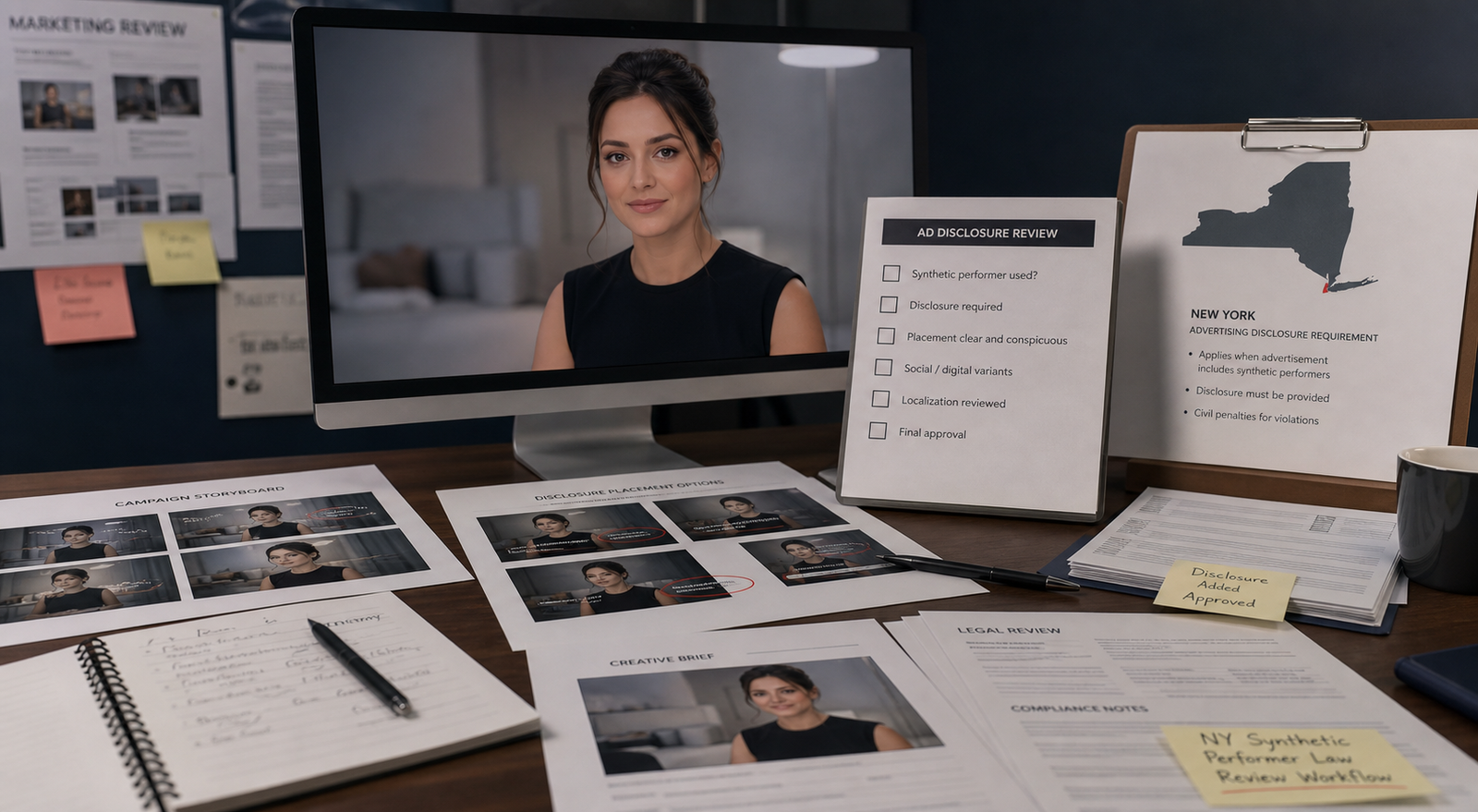
New York's synthetic-performer advertising law is the clearest example of a narrower approach.
As tracked in Clearon's published coverage, New York now requires disclosure when advertisements include AI-generated performers. That is a targeted rule aimed at a concrete commercial context. It is more readily confined to an identifiable commercial context than a broad rule that treats any realistic synthetic character or voice as inherently suspect across every setting.
This is the kind of example that supports the IPWatchdog point. A narrowly framed disclosure rule for advertising is very different from a generalized rule that could bleed into expressive media or product design.
2. Broader anti-forgery and persona-protection measures
Pennsylvania's Act 35 of 2025 and Ohio's pending HB 185 show a different lane.
Pennsylvania's tracked law is a broader digital-forgery measure, not just an election-deepfake statute. Act 35 addresses digital forgery through an enacted criminal framework tied to statutory intent requirements. Ohio's HB 185, which remains pending, would separately revise persona-use law and prohibit certain unauthorized deepfake recordings. Both raise scoping questions, but they regulate different conduct through different legal mechanisms.
That does not make them illegitimate. It does mean product teams, publishers, and counsel should ask harder scoping questions before assuming the rule cleanly maps to a game or creative-AI product:
- Is the law keyed to deception, consent, and impersonation?
- Does it distinguish commercial misuse from expressive use?
- Does it turn on a real person's identity, or on synthetic realism more generally?
- Does it leave room for licensed, parodic, or otherwise protected creative work?
Those distinctions matter a great deal in games, where character design, voice synthesis, likeness licensing, machinima-style content, and user-generated creations can all sit near the line.
3. Definition-heavy laws where carveouts and context do a lot of work
The election-deepfake statutes we track are not video-game laws, but they are still useful cautionary examples.
Clearon's comparison work already shows that California's AB 2655 and AB 2839 and New Mexico's HB 182 do not all solve the same problem in the same way. They use different combinations of prohibition language, disclosure mechanics, and satire/parody treatment.
California's measures are enacted, but their current enforcement posture is materially constrained by federal-court rulings. New Mexico's enacted HB 182 is also the subject of pending constitutional litigation. They remain useful drafting examples, not interchangeable statements of currently enforceable law.
That is the kind of drafting variation that can become decisive once a plaintiff argues that a law reaches protected expression more broadly than lawmakers intended. Even outside elections, the lesson carries over: if the operative definition is too blunt, the exceptions and carveouts end up doing enormous work, and courts may decide they do not do enough.
For game publishers and digital-content companies, that is the real operational warning. The hardest laws are not always the ones with the harshest rhetoric. They are often the ones whose definitions, exceptions, and disclosure triggers do not map cleanly onto the actual product context.
What Game and Creative-AI Companies Should Be Asking
The practical question is not whether regulation is coming. It is what category of regulation a product is most likely to attract, and whether the legal theory behind that category actually matches the feature being built.
Companies building or distributing AI-enabled creative tools, games, avatars, voice systems, or synthetic-character features should be able to answer:
- Is the main risk advertising deception, persona misuse, election content, consumer confusion, or some other category?
- Does the feature involve a real person's likeness, voice, or identifying traits?
- Is the output licensed, fictional, user-directed, editorial, or platform-distributed at scale?
- Would a required disclosure actually reduce a real risk, or would it simply create warning fatigue?
- If a law uses a broad synthetic-media definition, what part of the product would be exposed first?
That is where the tracker becomes more useful than a generic AI-policy debate. The tracked laws show that states are already choosing different regulatory instincts depending on whether the perceived harm is fraud, identity appropriation, political deception, chatbot dependence, or unsafe decision-making.
Read The IPWatchdog Piece And Watch The Episode
This is one of those source pieces that deserves direct attention rather than only secondhand summary.
If you care about how AI rules could land on games, digital replicas, creative tools, and software products built around expressive content, read Gene Quinn's article at IPWatchdog. Then watch or listen to the full IPWatchdog Unleashed conversation with Bijou Mgbojikwe through the podcast feed or the IPWatchdog YouTube channel.
Quinn's article and Mgbojikwe's analysis ask the right scoping question: how do you target real harm without writing rules so broadly that they interfere with lawful creative work, protected speech, or normal product design?
Bottom Line
The regulatory pressure that IPWatchdog is describing is not theoretical. Clearon's tracker already shows it.
Some laws are narrow and context-specific, like New York's advertising disclosure rule. Some are broader anti-forgery or persona-protection measures, like Pennsylvania's Act 35 and Ohio's pending HB 185. Others show how fast disclosure mechanics, prohibition language, and carveouts can become messy once lawmakers move from a headline harm to statutory text.
For companies in games and expressive AI, the principal mistake is treating every rule that uses the word "deepfake," "replica," or "AI" as though it targets the same conduct. Product teams need to examine the covered harm, statutory elements, exceptions, and current enforcement posture.
Sources and Related Clearon Coverage
- New York Governor announcement on synthetic-performer advertising disclosure law
- Pennsylvania Act 35 digital-forgery law
- Ohio HB 185 official legislature page
- New Mexico HB 182 enrolled act PDF
- California AB 2655 official status page
- California AB 2839 official status page
- IPWatchdog Unleashed article by Gene Quinn featuring Bijou Mgbojikwe
- IPWatchdog Unleashed podcast archive
- IPWatchdog YouTube channel
- Clearon on New York's synthetic-performer disclosure law
- Clearon on selected enacted state AI election laws
Leave a Reply