OpenAI's Copyright Summary-Judgment Fight Now Has a Public-Access Calendar
The next major filings in the consolidated OpenAI copyright litigation will not become fully visible all at once.
That is the point of a September 3 stipulated sealing order entered by Judge Sidney H. Stein in the Southern District of New York. The order does not decide the merits of the copyright claims. It does not finally determine which material will remain sealed. And it should not be read as a finding that OpenAI, Microsoft, publishers, authors, or other parties are entitled to keep the summary-judgment record from public view.
It does something narrower but still important: it sets a two-track calendar. Daubert briefing and summary-judgment exhibits can move through provisional sealing and later omnibus sealing motions. Summary-judgment briefs and Rule 56.1 statements follow a separate public-refiling process with earlier dates.
For companies and publishers watching the case, the dates now matter almost as much as the arguments.
What The Order Actually Does
The order is a stipulated omnibus sealing order for summary-judgment and Daubert briefing in In re OpenAI, Inc. Copyright Infringement Litigation, No. 1:25-md-3143-SHS-OTW. It applies to all cases in the consolidated proceeding.
The parties told the court that the coming briefing is expected to refer to or attach material designated as Protected Discovery Material under the protective order. They asked to handle many sealing issues through later omnibus motions after briefing, rather than through separate sealing motions at the moment every brief or exhibit is filed.
Judge Stein approved that structure.
The practical result is a two-track public-access schedule. Exhibits, expert reports, declarations, and Daubert materials may be provisionally sealed if they contain or refer to protected discovery material. Summary-judgment briefs and Rule 56.1 statements are treated separately, with earlier public-refiling dates and party-by-party sealing procedures.
That distinction matters because the briefs are where the parties' legal theories should become visible first. The evidentiary record may take longer.
The Key Summary-Judgment Dates
The court has already set the summary-judgment schedule: motions by September 4, 2026, oppositions by October 9, 2026, and replies by November 6, 2026.
The sealing order adds the public-access timing around those filings.
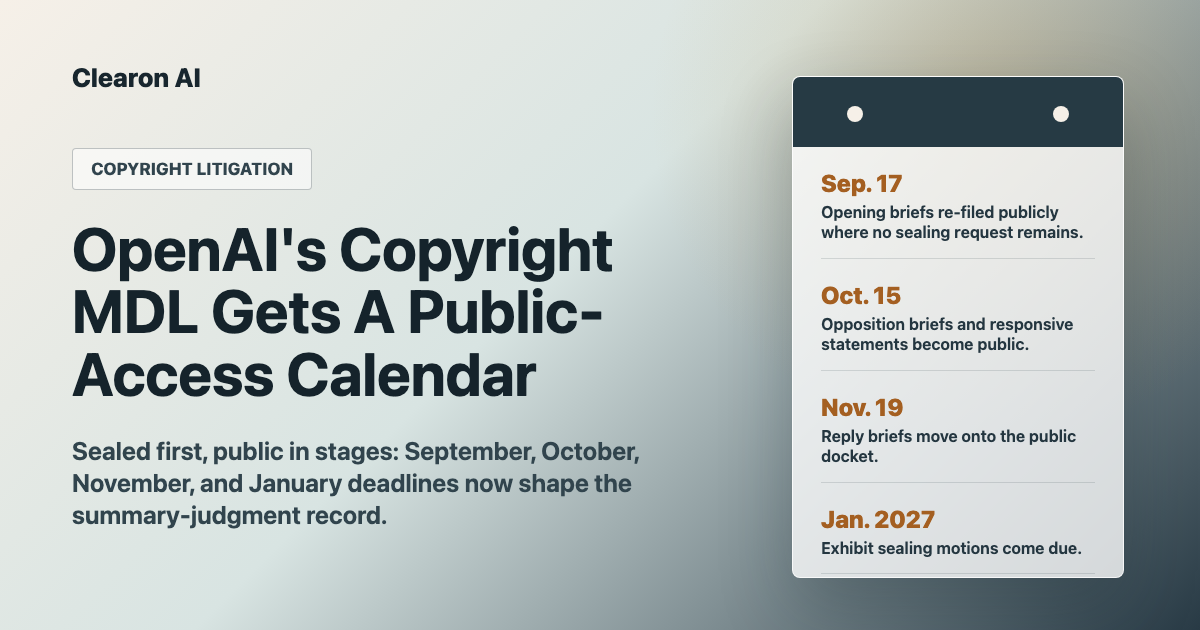
For opening summary-judgment briefs and Rule 56.1 statements, a moving party must file any motion to seal its own protected material by September 4. Other parties and third parties have until September 14 to support requests to maintain under seal portions of another party's brief or Rule 56.1 statement. By September 17, the parties must publicly re-file their summary-judgment briefs and Rule 56.1 statements, leaving unredacted the portions that no party or third party has sought to seal.
The same pattern repeats for oppositions. Opposition briefs and responsive Rule 56.1 statements are due October 9. Supporting statements for another party's proposed sealing are due October 14. Public refiling is due October 15 at 5:00 p.m. ET.
For reply briefs, sealing motions are due November 6. Supporting statements for another party's proposed sealing are due November 16. Public refiling is due November 19.
Those dates are now the public-access map for the merits phase of the case.
The Exhibits Move On A Slower Calendar
The order gives exhibits and expert materials a different timeline.
For Daubert briefing and summary-judgment exhibits, including expert reports and declarations, the parties may provisionally seal materials that contain or refer to Protected Discovery Material. The parties and affected third parties are relieved from the usual contemporaneous sealing-motion and short justification requirements for those provisionally sealed materials.
But the relief is temporary.
Anyone who wants provisionally sealed material to remain sealed must file an omnibus sealing motion by January 13, 2027. Responses are due January 20. Any provisionally sealed material that no party or third party moves to seal by January 13 must be publicly filed by January 27.
That is important for two reasons.
First, the January schedule means the public may see the legal briefs before it sees the full evidentiary fight. Second, it means the current order is not a final secrecy ruling. It is a staging order. It defers the sealing fight for many exhibits, but it also creates a deadline for that fight.
Why This Matters Beyond Procedure
OpenAI's copyright cases have already become one of the central legal battlegrounds over generative AI training, publisher substitution, retrieval systems, outputs, and licensing leverage.
The summary-judgment phase is where those arguments may become more concrete.
The court may be asked to decide, or at least frame, questions about training-stage fair use, market substitution, acquisition practices, output behavior, protected expression, and the weight of expert evidence. Those are not abstract issues for AI companies or rightsholders. They go directly to how AI developers build datasets, evaluate licensing exposure, structure retrieval and output controls, and explain risk to boards, customers, investors, and regulators.
That is why the sealing calendar deserves attention. Until the public filings appear, outside observers should be careful about any claim that one side's summary-judgment arguments have already won, collapsed, or shifted the law. The briefs may be filed under seal first. The public versions will arrive later, subject to redactions tied to pending sealing requests.
The safer takeaway is procedural: the merits fight is moving into summary judgment, and the public record is scheduled to emerge in stages, subject to later sealing decisions.
What Not To Overstate
There are three easy mistakes to avoid.
First, this is not a ruling on fair use. It does not decide whether OpenAI's training uses are lawful, whether particular outputs infringe, whether acquisition conduct matters separately, or whether publishers and authors can prove market harm.
Second, this is not a permanent sealing decision. The order permits provisional sealing and sets deadlines for later sealing motions. It also says nothing prevents a party from challenging another party's or third party's request to maintain material under seal.
Third, the order does not mean the public will have no meaningful access to the arguments. The opposite is closer to the point. It identifies specific dates when public refiling must occur for the summary-judgment briefs and Rule 56.1 statements, with unredacted material where no sealing request has been made.
In other words: the order creates a staged process for handling protected discovery material in a sprawling litigation record.
What To Watch Next
The first date to watch is September 17, when public versions of the opening summary-judgment briefs and Rule 56.1 statements are due. That is likely to be the first meaningful public window into the parties' merits arguments at this stage, subject to requested redactions.
The second date is October 15 at 5:00 p.m. ET, when public opposition briefs and responsive Rule 56.1 statements are due.
The third is November 19, when public reply briefs are due.
The fourth is January 13, 2027, when any party or third party seeking to keep provisionally sealed exhibits and expert materials under seal must file an omnibus motion. January 27 is the follow-on public-filing deadline for provisionally sealed materials no one moved to seal.
Those dates should guide how companies read the next wave of coverage. Early reports may be based on sealed docket entries, partial public material, party statements, or secondhand descriptions. The more reliable analysis will come after the public versions are filed and the court's sealing process narrows what remains subject to a sealing request.
Bottom Line
The September 3 order is not the copyright ruling everyone is waiting for.
It is the calendar that tells us when that fight becomes visible.
Opening summary-judgment arguments must be publicly re-filed by September 17 to the extent no party or third party has sought sealing. Opposition and reply briefs follow in October and November. Exhibits and expert materials may remain provisionally sealed longer, but the order sets January deadlines for formal sealing motions and public filing where no sealing request is made.
For Clearon readers, that means the next phase of the OpenAI copyright litigation should be tracked by date and document type, not just headline. The legal arguments, factual record, and expert evidence will not surface together. They are scheduled to emerge in layers, subject to later sealing decisions, and each layer may matter for AI training, publisher licensing, output controls, and copyright-risk planning.
Sources and Related Clearon Coverage
- Stipulated Omnibus Sealing Order for Summary Judgment and Daubert Briefing, In re OpenAI, Inc. Copyright Infringement Litigation, No. 1:25-md-3143-SHS-OTW
- Agenccy summary of the order (non-authoritative)
- Clearon: DOJ Urges Court To Treat LLM Training as Fair Use in OpenAI Copyright Case
- Clearon: wikiHow v. OpenAI Could Become a Clearer Test of AI Answer Substitution
- Clearon AI Litigation tracker
Leave a Reply