
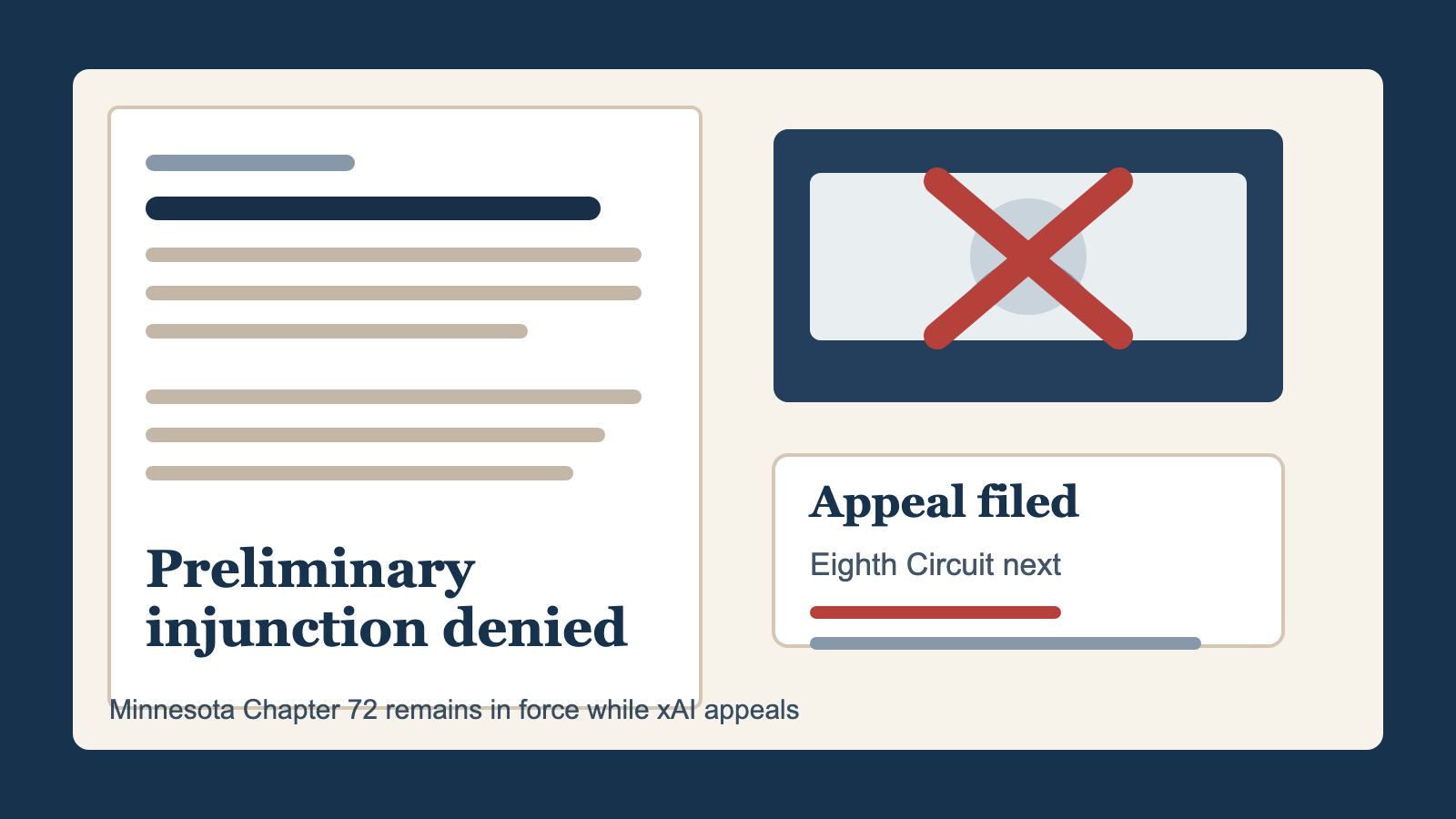
Minnesota's Nudification Law Survives xAI's Preliminary-Injunction Bid
Minnesota's AI nudification law remains in force after xAI lost its request for a preliminary injunction.
That is the immediate result of a September 4 order from Judge Donovan W. Frank in the District of Minnesota. The court denied xAI's bid to block enforcement of Minnesota Statutes section 325E.91 while the case proceeds. xAI filed a notice of appeal to the Eighth Circuit the same day.
The ruling matters because it is a live federal test of a state law aimed directly at covered nudification tools. But it should not be overstated. The court did not finally decide whether Minnesota's law is constitutional. It denied interim relief because xAI waited too long to seek emergency relief and did not make a sufficient showing of irreparable harm. The court also found that the balance of harms and public interest independently favored Minnesota.
For AI companies, the practical message is narrower and more immediate: constitutional objections may remain available, but they may not keep a state AI safety law offline during litigation.
What Changed Since The First Clearon Article
Clearon previously covered Minnesota's Chapter 72 after the court denied xAI's temporary restraining order before the law's August 1 effective date.
The new development is different. The court has now ruled on the preliminary-injunction request after briefing and argument. It again left the law in place, but this time in a longer memorandum opinion that addresses the injunction factors and the state's evidentiary showing.
The docket also moved quickly after the ruling. On September 4, xAI filed a notice of appeal from the order denying a preliminary injunction.
So the case is no longer just an emergency timing fight. It is now an active appellate test over whether Minnesota's tool-level approach can remain enforceable while the constitutional challenge continues.
What Minnesota's Law Does
Minnesota's Chapter 72 created section 325E.91, titled "Prohibition on Nudification Technology."
The statute prohibits a person who owns or controls a website, application, software, program, or other service from allowing a user to access, download, or use the service to nudify an image or video. It also prohibits nudifying an image or video on behalf of a user and bars advertising or promoting a service that performs those actions.
The law defines "nudify" as altering or generating an image or video to depict an intimate part not shown in the original unaltered image or video of an identifiable individual, where the result is realistic enough that a reasonable person would believe the intimate part belongs to that individual.
There is an exemption when the service requires the user's technical skill to nudify an image or video. The statute also says it does not alter or amend Section 230 protections and must be construed consistently with federal law.
The enforcement risk is substantial. The Minnesota Attorney General may enforce the law and seek civil penalties of up to $500,000 for each unlawful access, download, or use. A depicted individual may also bring a civil action for damages, punitive damages, injunctive relief, attorney fees, costs, and other equitable relief.
The law took effect August 1, 2026.
Why The Court Denied Interim Relief
The court's preliminary-injunction ruling rests on two main grounds: delay and irreparable harm, plus the balance of harms and public interest.
The delay point is direct. H.F. 1606 was signed on May 7. xAI filed its lawsuit and emergency motion near the end of July, roughly three months later and only days before the law took effect. Judge Frank wrote that xAI is a sophisticated and well-resourced litigant and that, if it genuinely feared irreparable harm, it would have acted more quickly.
That timing problem mattered both at the temporary-restraining-order stage and at the preliminary-injunction stage.
The court also rejected xAI's irreparable-harm showing. xAI pointed to the risk of large civil penalties, commercial injury, engineering work to implement Minnesota-specific controls, increased moderation, potential user loss, and alleged First Amendment injury.
The court found those showings insufficient for interim relief. It treated the civil penalties as monetary in nature. It noted that xAI had already disabled its nudification tool in Minnesota, making penalties unlikely on the record before the court. It also described xAI's evidence of engineering cost, moderation burden, and user loss as vague, conclusory, or speculative.
On the First Amendment point, the court did not say First Amendment harm can never be irreparable. It said that even in First Amendment cases, a movant must make a clear showing of likely irreparable harm, and delay can independently support denial of a preliminary injunction.
The Merits Are Still Open
The court did not resolve xAI's First Amendment challenge.
That distinction is important. The order says the parties "sharply contest" the strength of xAI's First Amendment claim. xAI argues it is likely to succeed. Minnesota disputes xAI's standing to assert its users' First Amendment rights, disputes xAI's own asserted First Amendment interest, and argues the statute is valid under any level of scrutiny.
Judge Frank called the constitutional issues complex, especially in the context of new technology and public risk. The court said those issues deserve full consideration and may be addressed in the future through the state's motion to dismiss or later permanent-injunction proceedings.
So this is not a final ruling that Minnesota's statute survives First Amendment review. It is a ruling that xAI did not justify blocking the law now.
That posture should shape how companies read the decision. The order is strongest as a lesson about emergency relief, evidentiary showings, and litigation timing. It is not yet a definitive answer on how far states may go in regulating generative image tools.
The Public-Interest Record Helped Minnesota
The court also found that the balance of harms and public interest tipped "steeply" in Minnesota's favor.
The order points to the legislative record around harms from AI nudification technology. It describes testimony about missed work, fear, family harm, and the emotional burden of realistic sexualized images and videos. It also cites evidence about widespread use of nudification apps, synthetic sexual images of adults and children, school-related harms, and reports involving AI-generated child sexual abuse material.
That record mattered because Minnesota framed the law as a response to a specific product-safety and victim-protection problem. The court accepted, for purposes of the preliminary-injunction balance, that the state has an interest in curbing the generation and proliferation of those images.
xAI's harm showing did not outweigh that public-interest evidence at the interim stage.
For future challenges to AI laws, that is a useful signal. Courts may look closely at whether the state built a factual record explaining the harm and whether the challenger can identify concrete, imminent harm from enforcement. Abstract concern about overbreadth may not be enough to suspend a statute while the merits are still pending.
What The Appeal Means
xAI's same-day notice of appeal keeps the fight alive.
The appeal does not automatically mean Minnesota's law is invalid, and it does not by itself suspend enforcement. Unless a court grants stay relief or reverses the district court's preliminary-injunction ruling, section 325E.91 remains in effect while the litigation continues.
The appeal also means the Eighth Circuit may soon have to address how emergency-relief principles apply to state AI laws that regulate expressive tools, user misuse, product controls, and synthetic sexual imagery.
That is a narrower appellate question than the ultimate merits question. An appellate court reviewing a preliminary-injunction denial can focus on delay, irreparable harm, balance of equities, public interest, and likelihood of success without finally deciding every constitutional issue.
Even so, the appeal will be watched closely because the underlying statute is unusual. Minnesota did not merely create a takedown system after abusive content is posted. It restricted covered access to nudification functionality itself.
What AI Companies Should Do Now
Companies offering image generation, image editing, avatar tools, video generation, or transformation features should treat this as a live compliance development.
The first question is not whether Minnesota will ultimately win. The first question is whether the company can explain, today, whether its product lets users generate realistic altered depictions of intimate parts of identifiable people and what controls prevent that result.
Product, legal, and trust-and-safety teams should be able to answer:
- whether the system can create the category of output Minnesota defines as "nudified";
- whether controls operate before generation, before export, before sharing, or only after abuse reports;
- whether geographic controls have been implemented for Minnesota users;
- whether logs can show what controls were active at the relevant time;
- whether policy enforcement is enough under a statute aimed at service access rather than only user misconduct;
- whether any relied-on "technical skill" argument is actually supported by product design; and
- how the company would respond if another state copied Minnesota's access-level model.
This is especially important because the district court considered xAI's already-implemented Minnesota controls when weighing harm. A company that waits until enforcement is imminent may have a harder time arguing that compliance work, moderation burden, or lost users justify emergency court relief.
What Not To Overread
There are three limits to keep in view.
First, the order does not decide whether Minnesota's law is constitutional.
Second, the order does not say every state law aimed at AI image tools will survive. It is tied to this statute, this record, xAI's timing, and xAI's evidence of harm.
Third, the order does not erase federal-law questions. Minnesota's statute expressly says it does not alter Section 230 protections and must be construed consistently with federal law. How that clause works in practice may matter later.
The safer reading is practical: Minnesota's law stays active for now, and challengers to similar AI laws will need a stronger emergency-relief record if they want to stop enforcement before the merits are decided.
Bottom Line
Minnesota has won the first full preliminary-injunction round in the xAI challenge to its nudification law.
That does not settle the First Amendment merits. But it does leave Minnesota's tool-level nudification statute in effect while xAI appeals.
For AI companies, the compliance takeaway is immediate. If a state law regulates access to a covered image-generation or editing function, waiting until the eve of enforcement to challenge it can weaken the emergency-relief case. And if a company has already built state-specific controls, it should preserve the evidence showing what changed, when it changed, and why.
The next phase will likely unfold in the Eighth Circuit. Until then, Minnesota's law remains a live example of how states may try to regulate AI-enabled synthetic intimate imagery upstream, at the product-access layer.
Leave a Reply