
Kohls v. Ellison Did Not End Minnesota's Election AI Law Fight on the Merits
Minnesota is easy to misread if you look only at the result.
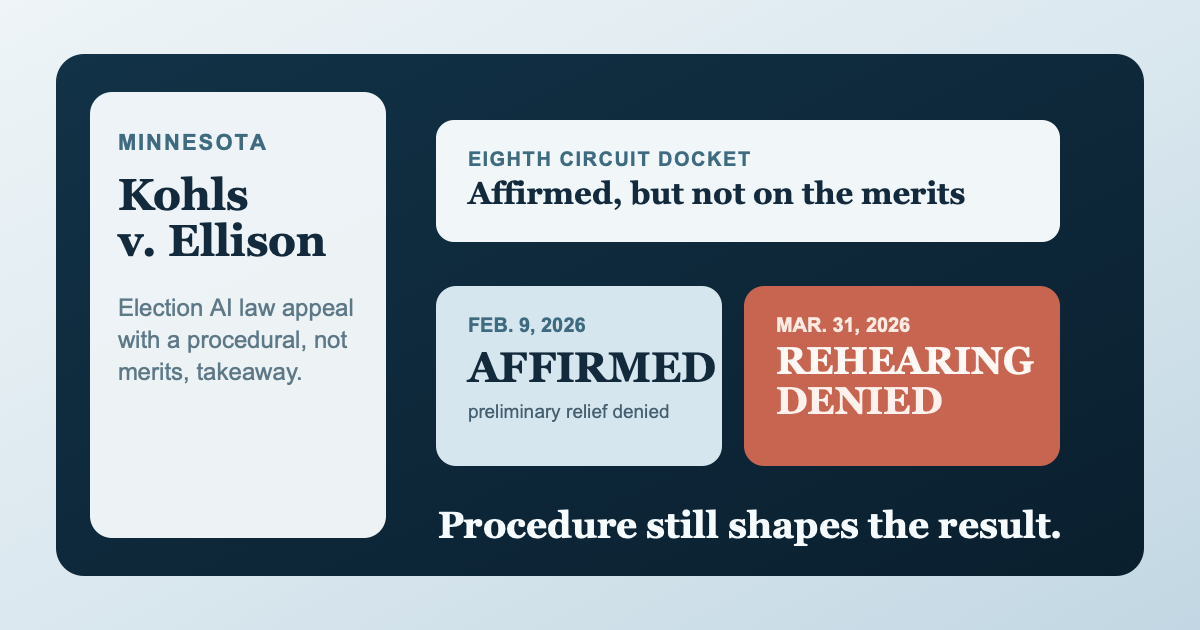
The challengers in Kohls v. Ellison did not win preliminary relief against Minnesota's election deepfake statute. The Eighth Circuit affirmed the district court, and rehearing was later denied.
That can sound like a clean appellate approval of the law. It was not.
The more careful description is that the Eighth Circuit affirmed without resolving the underlying constitutional merits of the statute itself. That makes Minnesota an important but limited precedent in the growing fight over election-related AI laws.
The statute sits in the same field, but the case is different
The operative law is Minn. Stat. § 609.771, titled "Use of deep fake technology to influence an election."
Minnesota therefore belongs in the same general field as California, Hawaii, New Mexico, Arizona, and other states regulating synthetic election media in some form. But its litigation story is procedurally different from the Babylon Bee cases.
That difference is the whole point.
What happened on appeal
The Eighth Circuit appeal in No. 25-1300 came from the district court's denial of preliminary relief.
The appellate docket shows that judgment was entered on February 9, 2026, affirming in accordance with the panel opinion. Later entries show that the appellants sought rehearing and rehearing en banc, and that both requests were denied on March 31, 2026.
That gives Minnesota a firmer appellate procedural history than some other election-AI cases now cited around the country. But it does not mean the Eighth Circuit gave the statute a sweeping constitutional endorsement.
Why the merits limitation matters
The best way to describe Minnesota's significance is narrow.
A lot of commentary collapses "the plaintiffs lost the injunction appeal" into "the law was upheld." Those are not always the same thing. A court can deny preliminary relief without giving the state a full merits victory on the substance of the First Amendment challenge.
That is what makes Minnesota useful but incomplete as precedent.
What Minnesota does tell other states
Minnesota still carries real lessons.
First, plaintiff-specific delay matters. The Eighth Circuit treated Mary Franson's insufficiently explained sixteen-month delay as fatal to the irreparable-harm showing required for preliminary relief.
Second, standing still does real work in this area. The court held that Christopher Kohls had not established standing on the preliminary-injunction record, while Franson had standing to press her own challenge.
Third, the absence of preliminary merits relief does not eliminate litigation risk for similar statutes elsewhere. It means only that the Minnesota challengers did not obtain the procedural posture they needed.
Why Minnesota still matters for New Mexico and the Bee cases
Minnesota is not a Babylon Bee case, and that distinction matters.
The Bee cases put pressure on satire, parody, and compelled-warning issues in a specific way. Minnesota's appeal posture is most useful for a different lesson: a state can survive the preliminary-injunction stage without obtaining a full appellate ruling that its law is constitutional.
So if the point is that challengers can lose early because one plaintiff lacked standing and another waited too long to show urgency, Minnesota helps. If the point is that an appellate court has already blessed the constitutional merits of a state election-AI law, Minnesota does not support that proposition.
Bottom line
Kohls v. Ellison did not end Minnesota's election-AI fight with a sweeping merits decision.
What it shows instead is how much election-law procedure can shape outcomes. The Eighth Circuit affirmed the denial of preliminary relief, rehearing was denied, and the district case remained alive afterward.
The cleaner takeaway is narrower but still important: Minnesota shows that a state can survive an early challenge without receiving a full appellate ruling on whether its election-AI law ultimately survives First Amendment scrutiny.
This article summarizes a pending election-law challenge and related procedural rulings. It does not provide legal advice.
Leave a Reply