D.C. Court Says AI Citation Ignorance Is No Longer Credible
The D.C. Court of Appeals has now said the quiet part plainly: lawyers can no longer credibly claim they did not know generative AI can invent legal authority.
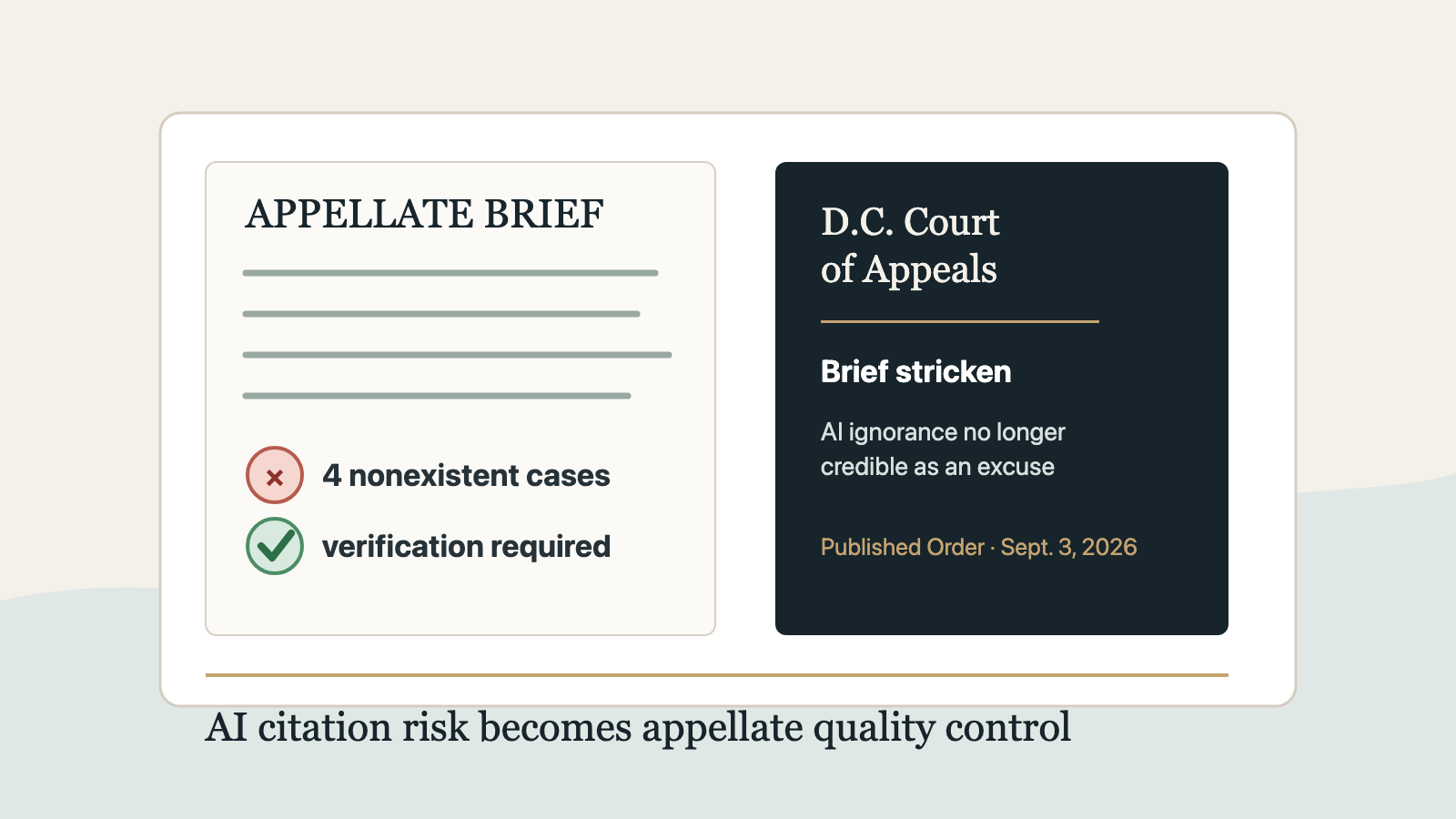
In Douglas v. Deutsche Bank National Trust Co., the court struck Deutsche Bank's appellee brief after discovering four nonexistent cases. The order says one of Deutsche Bank's lawyers used Google's generative AI search tool to assist in finding authority and did not verify the cited cases before the brief was filed.
That would be enough for a short sanctions note.
But the published order is more useful than that. It treats the fake citations as a supervision, competence, and appellate-rule problem. It also exposes a harder institutional question: what should an appellate court do when its existing rules let it strike a defective brief and refer the matter for discipline, but may not clearly authorize more targeted sanctions against the lawyers responsible?
That makes Douglas worth reading beyond the usual warning not to paste AI output into a brief.
What Happened
The appeal started as a foreclosure case. Deutsche Bank had won judgment on the pleadings in D.C. Superior Court, and Barry Douglas appealed without counsel.
After the appeal was submitted without argument, the D.C. Court of Appeals reviewed Deutsche Bank's brief and found multiple case citations it could not locate or confirm. On June 22, the court ordered Deutsche Bank to show cause why the brief should not be struck for citing nonexistent cases that were possibly the product of AI hallucinations.
The next day, attorney Loishirl W. Hall responded in her own capacity. According to the order, she confirmed that four cited authorities did not exist and acknowledged that they were not legitimate legal authority. She explained that she had used Google's generative AI search tool to help locate case authority and had not verified the existence or accuracy of the citations before filing.
The firm, McCabe, Weisberg & Conway, filed a separate response. The order says the firm represented that it prohibits employees from using AI in drafting legal correspondence or documents and trains employees that citations must be verified regardless of source. But the court noted that the firm did not attach the policy and did not detail what it had done to supervise or review Hall's work.
The court's result was direct: Deutsche Bank's brief was stricken.
It also referred the matter to the Office of Disciplinary Counsel for whatever investigation that office deems appropriate.
The Court's Real Message
The order is not anti-AI. It says the court's intent is not to discourage lawyers from using AI and acknowledges that lawyers may now need at least an understanding of AI at their own peril.
The line the court draws is different.
AI use does not change the lawyer's duty to verify legal authority. The order says the use of AI is now so pervasive in legal practice that lawyers can no longer credibly claim ignorance of its pitfalls, including hallucinated legal authority. It cites ABA Formal Opinion 512, D.C. and other professional-responsibility guidance, and a growing body of court decisions involving fabricated AI citations.
That framing matters because it moves the issue out of novelty territory.
A lawyer who files a brief with fake cases is not just making a technology mistake. The conduct potentially implicates duties of competence and candor. The tool may explain how the error entered the draft. It does not excuse the filing.
The order also rejects a common mitigation argument: that some real authority existed elsewhere in the brief. A hallucinated citation, the court says, is worse than no citation. It wastes court resources, misdirects the court, deprives the client of credible advocacy, and undermines the adversarial process.
The Firm-Supervision Point
One of the most important parts of the order is its treatment of the law firm response.
The firm tried to separate itself from the attorney who used the AI search tool. The court was not satisfied with that posture. It emphasized that every firm attorney whose name appeared on the brief bore some responsibility, and it faulted the absence of detail about how the firm supervised or reviewed the work.
That is the operational lesson for law firms.
A policy against AI drafting is not enough if the firm cannot show how the policy is communicated, enforced, and built into filing review. Nor is annual training enough if no one can explain who checked the authorities before the brief went out.
The concurrence is especially useful on this point. Senior Judge Glickman did not say every lawyer listed on a complex brief must personally check every citation. He recognized that citation verification can be a group effort. But he also pointed toward concrete controls: training and retraining lawyers, adopting clear AI-use policies, requiring lawyers to confirm compliance, and using trained paralegals or other review processes to check citations and case descriptions before filing.
That is a more realistic governance model than either banning AI in theory or requiring every senior lawyer to redo every cite check personally.
The Sanctions Gap
The unusual part of Douglas is not just the fake citations. It is the court's discussion of remedy.
The panel struck the brief under D.C. Appellate Rule 28 and referred the matter to disciplinary counsel. But it also referred the sanctions-authority question to the court's Rules Committee for analysis and possible clarification.
Judge Glickman's concurrence explains why.
Federal courts have used several tools in AI citation cases, including Rule 11, appellate disciplinary rules, inherent authority, fee shifting, monetary sanctions, bar referrals, and suspension. The D.C. Court of Appeals does not have exactly the same rule structure. The concurrence says D.C. Appellate Rule 38 is aimed at frivolous appeals, petitions, or motions, not ordinary briefs containing some fake citations. D.C. Appellate Rule 46 addresses admission to the bar, not attorney discipline for conduct unbecoming a member of the bar. Inherent-authority sanctions require bad faith, and the existing record did not establish that Hall or the firm acted intentionally, knowingly, recklessly, or with bad faith rather than negligently or incompetently.
That left the court with what the concurrence called a comparatively weak response: striking the brief, which can penalize the client for counsel's misconduct, plus public admonishment and disciplinary referral.
That institutional problem is important. AI citation failures are becoming common enough that appellate courts may need remedial tools calibrated to lawyer conduct rather than only party consequences.
Why This Is Different From The Usual Hallucination Story
There have already been many AI citation cases. Clearon has covered several of them.
Douglas adds three useful points.
First, it is a published order from D.C.'s highest local court. That gives the decision weight in a jurisdiction with its own appellate rules and professional-responsibility system.
Second, the court expressly says ignorance of generative AI citation risk is no longer credible. That is a clean marker for law firms that still treat AI training as optional background rather than core competence.
Third, the concurrence shifts the discussion from punishment after failure to governance before filing. The point is not merely "check your citations." It is build a review process that can catch both fabricated authorities and subtler AI-generated inaccuracies.
That last point matters because fake case names are not the hardest problem. They are often the easiest to find. The concurrence warns that AI inaccuracies may be more dangerous because they can cite real authorities for propositions those authorities do not support, confuse party arguments with holdings, or mishandle the hierarchy of authority.
For legal teams, that means a citation-validation process should not stop at existence checks. Someone still has to read the source and confirm that the quoted language, holding, proposition, jurisdiction, and procedural posture are right.
What Legal Teams Should Do Now
The practical controls are not exotic.
Law firms and legal departments should require every filing workflow to answer five questions before submission:
- Who used AI, if anyone, and for what task?
- Who verified that every cited authority exists?
- Who checked that each authority supports the proposition for which it is cited?
- Who reviewed quotations, parentheticals, procedural descriptions, and record references?
- Who owns escalation if a court or opposing party flags a possible hallucination or unsupported citation?
Those questions should be answered in the workflow, not after a show-cause order.
AI policies also need to distinguish between search, drafting, summarization, cite checking, and final advocacy. The risks are different. A lawyer using an AI search feature to find authority still must verify the source. A lawyer using AI to draft arguments raises a deeper problem because the lawyer may outsource the judgment that advocacy requires.
That is why the safest firm policy is not a slogan about whether AI is allowed. It is a documented review path for each use case, backed by supervision, training, file-level certification, and a plan for candor if something goes wrong.
Bottom Line
Douglas is not a ruling that lawyers may never use AI.
It is a warning that AI use has become ordinary enough that courts now expect ordinary competence around it.
The D.C. Court of Appeals struck Deutsche Bank's brief because fake citations reached the appellate record. It referred the matter for possible discipline. And it flagged that its own rules may need a better sanctions mechanism for AI-fabricated citation cases.
For law firms, the takeaway is simple: AI citation risk is no longer a training footnote. It is part of appellate quality control, supervision, professional responsibility, and client protection.
Sources and Related Clearon Coverage
- CourtListener page for the Douglas v. Deutsche Bank National Trust Co. published order, No. 24-CV-1099
- Published order PDF, Douglas v. Deutsche Bank National Trust Co., No. 24-CV-1099
- ABA Formal Opinion 512 on Generative Artificial Intelligence Tools
- Clearon: From a Stricken Filing to an $8,000 Fine: How Courts Calibrate Citation Failures
- Clearon: AI Sanctions Are Moving Beyond Fake Cases
- Clearon: Courts Are Turning AI Filing Rules Into Verification Duties
Leave a Reply