The easiest way to summarize state election-AI laws is to sort them into disclosure laws and prohibition laws.
That summary helps, but only up to a point.
One of the sharper fault lines in the selected state cluster is satire and parody.
Once a statute reaches political memes, ridicule, caricature, parody videos, or other obviously expressive content, the legal problem changes. The fight stops being only about synthetic deception and starts becoming a First Amendment fight over how a state treats speech that is false in a literal sense but often protected in context.
That is why satire and parody are a central comparison point in this selected-state field.
Disclosure Versus Prohibition Is Not The Whole Story
Many state election-AI laws already mix techniques.
Some use disclosure language. Some use prohibition language with safe harbors. Some pair a liability rule with an exception, exclusion, or prescribed warning. The same statute can look like a disclosure law from one angle and a prohibition law from another.
That is why the older binary starts to break down.
A better question is simpler: when satire or parody is involved, what does the statute actually do?
Three Practical Buckets
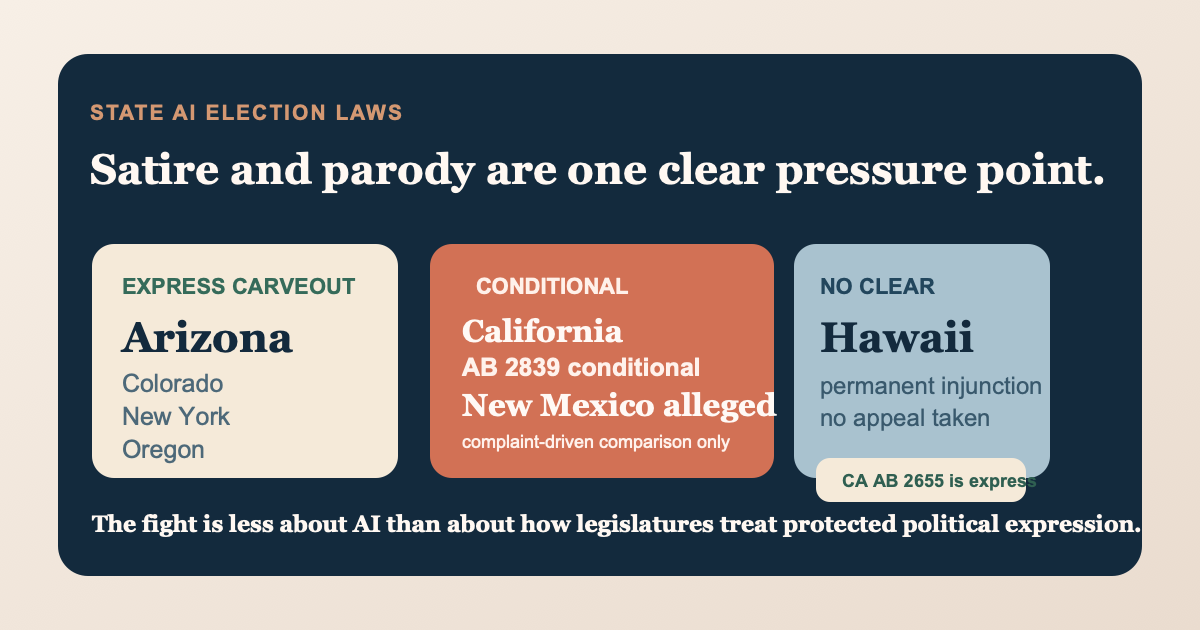
For a selected-state comparison, the working split that makes the most sense right now has three buckets:
- Express carveout
- Conditional carveout
- No clear carveout
An express carveout means the statute excludes satire or parody from the operative restriction.
A conditional carveout means the statute mentions satire or parody but still ties lawful use to a disclaimer, label, or other required treatment.
A no-clear-carveout statute is one where satire or parody is not clearly spared, or where the text is too thin or too muddled to summarize confidently as a real exemption.
This framework is not elegant. It is useful.
Arizona Shows The Cleanest Express Carveout
Arizona is the easiest place to start.
Its enacted Chapter 199 is one of the clearer examples of an express satire/parody exclusion in this area. That matters because Arizona gives courts and drafters a model for what it looks like when a legislature actually decides to keep parody outside the statute's operative reach.
That does not end every constitutional question. It does show that a state can draft more precisely than many of its peers.
Colorado, New York, and Oregon also fit more comfortably in the express-carveout conversation based on the enacted measures cited in Clearon's selected-state comparison.
California Is The Best Example Of Why One State May Need Two Labels
California is where shorthand causes trouble.
If you say California has a satire/parody carveout, that is partly true and partly too broad. If you say California only uses a disclosure-conditioned model, that is also incomplete.
The cleaner explanation is that California's two enacted 2024 laws need to be split, and that their current litigation posture should be kept in view.
AB 2655 contains an express satire/parody exemption inside a broader platform-duty regime, while AB 2839 is the more disclosure-conditioned and speaker-facing statute. Both laws drew district-court relief in 2025, and the cited March 2026 appellate filings are tied to the AB 2655 side of the case rather than a single unified merits ruling across both statutes. That split is one reason California has become such an important litigation state. The constitutional arguments do not attach to one perfectly unified statutory model.
So California is not just a comparison state. It is a warning about over-compression.
New Mexico Shows Why A Conditional Carveout Still Draws Fire
New Mexico is useful because it tests a purported middle category.
The Bee's complaint there argues that the challenged year-round advertisement-disclaimer regime does not truly exempt satire and parody in a meaningful way. On that theory, the state is not banning parody outright, but it is still burdening it by forcing a government-prescribed AI warning onto the message.
That is the core purported-conditional-carveout problem.
New Mexico's defendants had not yet answered when this draft was prepared, so the cleaner frame is narrower. The Bee alleges that the compelled label changes the message and cuts against the point of the satire itself, and the complaint also cites a nonbinding state attorney-general opinion that treated the satire language as providing no meaningful exemption beyond the disclaimer already required elsewhere in the statute. That means this article is using New Mexico as an alleged conditional-carveout model under current pleadings, not as a final judicial holding about what the statute means.
That is not a side issue. It is the main constitutional question.
Hawaii Shows What Happens When Courts Do Not See A Real Carveout
Hawaii is the cautionary example on the other side.
In The Babylon Bee v. Lopez, the district court granted summary judgment to the plaintiffs and permanently enjoined Act 191 on January 30, 2026. The court's reasoning was broader than the carveout issue alone, but the absence of a sufficient explicit or implicit satire/parody exception was still one important part of the analysis. That is why Hawaii fits best in the no-clear-carveout bucket.
Hawaii matters because it shows that a court may not be satisfied by broad state assurances that the law is aimed at deception rather than humor. If the text does not clearly protect the expressive category, the state may still lose on broader First and Fourteenth Amendment grounds. Hawaii officials later closed the case without appealing.
Why This Is The Real Doctrinal Pressure Point
The common feature across these statutes is not merely that they regulate AI. It is that they regulate political communication that may include AI-generated image, audio, or video.
Once that communication also includes satire or parody, the state is no longer only policing falsity. It is touching a form of political expression that often works by exaggeration, inversion, and deliberate literal untruth.
That is why courts are likely to care less about abstract labels like "disclosure law" or "deepfake law" and more about the exact treatment of parody in the operative text.
This is also why a state can lose even if it has a plausible anti-deception purpose. Purpose alone does not answer the compelled-speech and overbreadth problems.
Bottom Line
In the selected statutes and current Bee litigation, one of the clearest splits is not just disclosure versus prohibition.
It is whether the statute clearly protects satire and parody, protects them only on conditions, or does not protect them clearly at all.
Arizona, California, Hawaii, and New Mexico are useful comparison states precisely because they do not all answer that question the same way. For lawyers, legislators, and judges studying this selected-state cluster, that is where one of the clearest current pressure points sits.
Sources and Related Clearon Coverage
- Arizona Chapter 199 enacted text
- Colorado HB 24-1147 enacted measure
- California AB 2655 bill status
- California AB 2839 bill status
- New Mexico HB 182 enrolled act
- New York S9678 enacted bill page
- Oregon SB 1571 enacted measure overview
- Babylon Bee v. Castillo complaint
- New Mexico HB 182 bill text showing satire/parody clause
- Babylon Bee v. Lopez permanent injunction order
- Babylon Bee v. Lopez docket
- Hawaii case-closure announcement
- Ninth Circuit appellees' answering brief in No. 25-6138
- Hustler Magazine v. Falwell opinion
- Selected-state comparison article
- New Mexico Babylon Bee article
Leave a Reply