
Seattle Times and Newsday Add Trademark Dilution to the OpenAI Publisher Fight
The newest newspaper suit against OpenAI and Microsoft is not just another training-data complaint.
The Seattle Times Company and Newsday LLC filed a seven-count complaint in the Southern District of New York on September 4, 2026. The case accuses OpenAI entities and Microsoft of using the publishers' journalism without permission in generative AI systems, including ChatGPT, Copilot, and Bing Chat.
That part fits the broader publisher-litigation pattern.
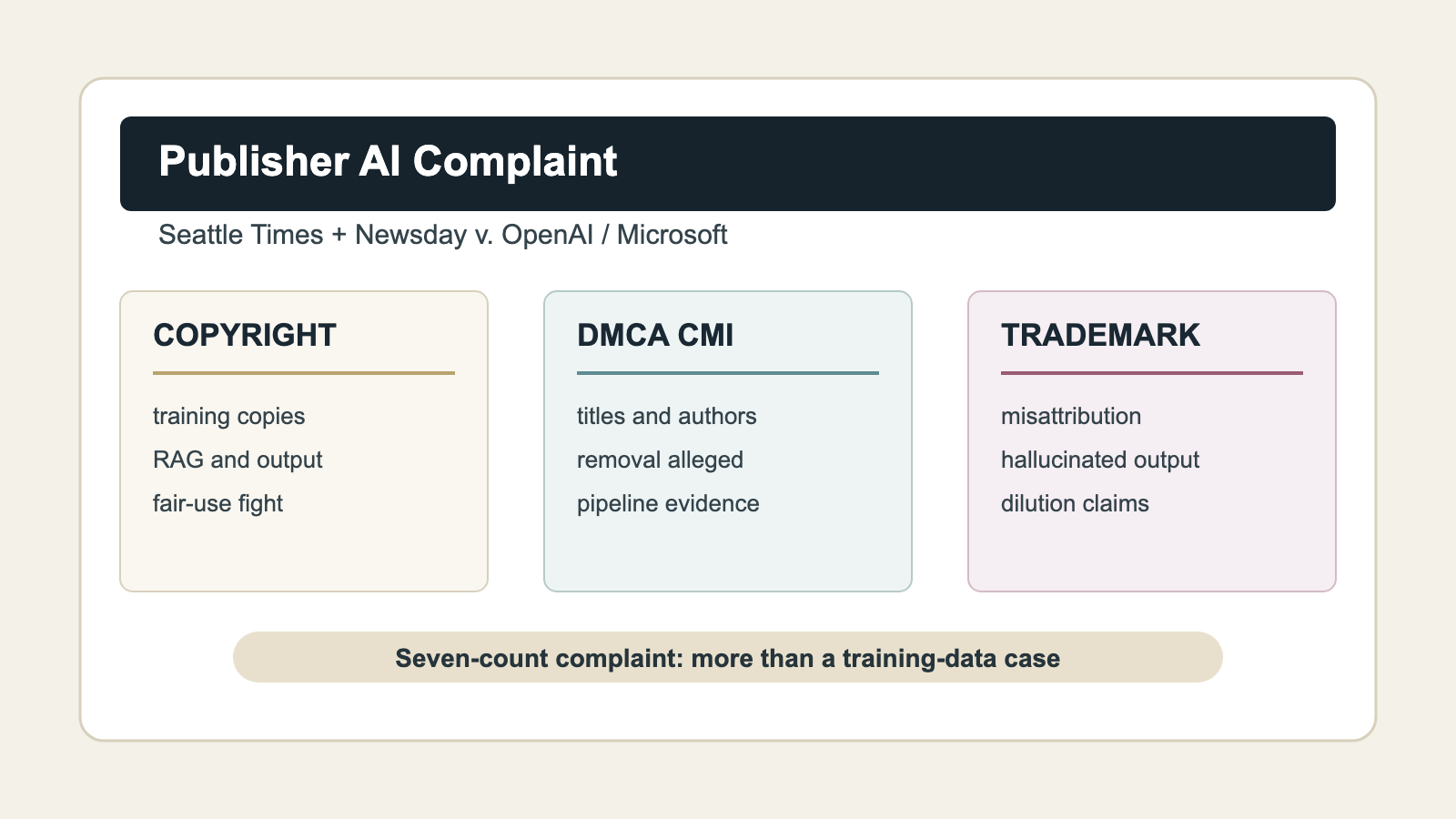
The more interesting feature is the claim mix. The complaint pleads copyright infringement, vicarious copyright infringement, two DMCA copyright-management-information counts, and three trademark-dilution counts. In other words, the case is not framed only around whether model training is fair use. It also tries to make allegedly hallucinated or misattributed AI output a brand-injury problem.
For companies building or deploying AI answer products, that is the part worth watching.
What The Complaint Alleges
The complaint says OpenAI and Microsoft copied large quantities of Seattle Times and Newsday journalism without permission or compensation. The publishers allege the defendants obtained articles by scraping their websites, bypassing paywalls, using datasets derived from WebText, WebText2, Common Crawl, and Microsoft's Bing search index, and then using that material to train, fine-tune, ground, and operate large language models.
Those are allegations, not findings. OpenAI and Microsoft have not lost this case. No court has ruled that the complaint's factual claims are true.
But the pleading is concrete enough to matter. It identifies The Seattle Times and Newsday as regional publishers with long-running copyright-registration programs, registered marks, paywalled websites, and active claims that AI systems can reproduce or closely paraphrase their journalism.
The complaint also alleges output examples. It says ChatGPT reproduced an 88-word passage from The Seattle Times' Pulitzer-winning Boeing 737 MAX coverage after being prompted with the headline and URL. It also includes Newsday examples where model output allegedly tracked or reproduced article text.
That is the copyright side of the case. The complaint's broader move is to connect those alleged outputs to two other theories: DMCA removal or distribution of copyright management information and dilution of the newspapers' marks.
The Seven Counts
The complaint pleads seven counts.
Count I is direct copyright infringement under 17 U.S.C. section 501. The publishers allege that copies of their works were reproduced, stored, processed, used in training datasets, used for training, fine-tuning, and grounding, and disseminated through generative output containing copies or derivatives.
Count II pleads vicarious copyright infringement against Microsoft and several OpenAI-related entities. The theory is that Microsoft and parent or affiliated OpenAI entities allegedly had the right and ability to control the infrastructure and conduct that produced the copying, while also profiting from it.
Counts III and IV are DMCA claims under 17 U.S.C. section 1202(b). Count III alleges removal of copyright management information such as author names, titles, copyright notices, and terms-of-use information. Count IV alleges distribution of works or output knowing that copyright management information had been removed.
Counts V, VI, and VII are trademark dilution. Count V is a federal Lanham Act dilution claim. Count VI is a Washington dilution claim for The Seattle Times. Count VII is a New York dilution claim for Newsday.
That structure matters because it pushes the case beyond the now-familiar training-copying fight.
Why The Trademark Counts Are The Signal
Most AI publisher cases are described as copyright cases, and many of them are. This complaint is broader.
The trademark-dilution counts rest on a different harm theory. The publishers allege that OpenAI and Microsoft products reproduce, output, and associate THE SEATTLE TIMES and NEWSDAY marks with AI-generated material that the publishers did not create, review, or publish. The complaint characterizes this as both blurring and tarnishment.
That is a useful distinction for AI companies.
Copyright law asks whether protected expression was copied, whether a use is infringing, whether fair use applies, and what remedies follow. Trademark dilution asks whether a famous or distinctive mark is being impaired or tarnished by association with someone else's product or output.
The complaint's theory is that hallucinated or misattributed AI answers can do more than copy text. They can attach a publisher's name to inaccurate, fabricated, or substandard content and thereby weaken the source-identifying value of the mark.
That theory will have hurdles. Trademark dilution is not a shortcut around copyright doctrine, and the plaintiffs still have to prove the elements of each claim. But the pleading is a reminder that output governance is not only about avoiding verbatim reproduction. It is also about attribution, brand association, source labeling, and whether users may believe a reputable publisher stands behind text it never reviewed.
The DMCA Counts Also Matter
The DMCA counts are quieter but potentially important.
The publishers allege that their articles carried copyright management information, including copyright notices, author and title information, and terms-of-use information. They then allege that OpenAI and Microsoft removed that information while building datasets, training and operating models, and generating output containing copies or derivatives.
The second DMCA count alleges distribution of works or generated output with that information removed.
Those claims can matter even where the core copyright issue is contested. A defendant might argue about fair use for training, while still facing separate questions about whether copyright-management information was stripped or omitted in a way section 1202 forbids.
That does not mean the DMCA claims will succeed. Courts have not treated every metadata or attribution omission as a section 1202 violation. The point is narrower: the complaint asks the court to look at the data pipeline and output pipeline, not just the final model-training question.
For AI governance teams, that makes provenance and attribution controls more than a content-policy nicety. They can become litigation facts.
The Requested Remedy Is Aggressive
The prayer for relief asks for damages, profits, injunctions, and attorney fees. It also asks the court to order impoundment or destruction, under 17 U.S.C. section 503, of copies of the publishers' works and all LLMs and training datasets incorporating those works or derivatives.
That remedy request will draw attention, but it should be read carefully.
A complaint can ask for broad relief at the start of a case. That does not mean the court will grant it. It does not mean a court has found that any model must be destroyed. And it does not mean the defendants lack defenses.
Still, the request shows how plaintiffs are framing leverage. They are not asking only for a license fee after the fact. They are asking the court to treat the alleged copying as embedded in datasets, model systems, and commercial products.
That framing is why these cases matter beyond one pair of newspapers.
How This Fits With The Existing OpenAI Copyright Fight
The timing is notable. The Seattle Times and Newsday complaint was filed the same day summary-judgment motions were due in the consolidated OpenAI copyright litigation before Judge Sidney H. Stein.
Clearon has already covered that public-access calendar. The merits briefing in the consolidated case is expected to become visible in stages, with opening summary-judgment briefs and Rule 56.1 statements due for public refiling on September 17 to the extent no party or third party seeks sealing.
That means this new complaint lands while the broader OpenAI copyright fight is moving into a decisive merits phase.
The new case is separate at filing. The complaint's docket is No. 1:26-cv-07644. But it was filed in the same district, against OpenAI and Microsoft, and it overlaps with the same broad questions about publisher content, training data, retrieval, output substitution, and fair use.
The practical point is that companies should not treat the OpenAI litigation map as one monolithic case. Different plaintiffs are testing different combinations of claims. This one adds a strong masthead and attribution angle.
What Not To Overstate
There are four easy mistakes to avoid.
First, this is a complaint, not a ruling. The allegations are unproven.
Second, the trademark counts do not automatically solve the copyright case. They add a separate theory tied to brand dilution, hallucinated attribution, and association with AI-generated output.
Third, the remedy request for destruction of models and datasets is a demand, not an order. It is important because of what it signals, but it is not an operative court command.
Fourth, the case does not answer the fair-use question pending in the broader OpenAI litigation. The defendants can still argue that training-stage copying is lawful, that output examples are not legally sufficient, that DMCA elements are not met, or that trademark dilution is not available on these facts.
The safer reading is that the case expands the pressure points.
What To Watch Next
The first thing to watch is whether the case is related, coordinated, or otherwise drawn into the orbit of the existing OpenAI copyright proceedings in the Southern District of New York.
The second is how OpenAI and Microsoft respond to the trademark-dilution counts. If they move to dismiss, the court may have to decide how far publisher-brand theories can go when the alleged harm comes from AI output rather than traditional source confusion.
The third is whether the DMCA counts survive early motion practice. Section 1202 claims often turn on knowledge, causation, and whether removed information plausibly enabled or concealed infringement.
The fourth is how the complaint's output examples hold up. The more specific and reproducible the examples are, the more pressure they may put on controls around memorization, retrieval, attribution, and paywalled content.
For AI companies, this is the operational lesson: copyright-risk controls and brand-risk controls cannot be separated cleanly. Training data, retrieval stores, output filters, attribution rules, and refusal behavior all create the factual record future plaintiffs will use.
Bottom Line
The Seattle Times and Newsday case is not just another publisher complaint against OpenAI and Microsoft.
It is a seven-count pleading that combines copyright, vicarious liability, DMCA CMI, and trademark-dilution theories. The copyright claims will get the headline, but the trademark counts may be the more useful governance signal.
If a model generates text that users associate with a real publisher, the risk is no longer only whether protected expression was copied. It may also be whether the output misuses the publisher's name, weakens its brand, or attaches that mark to content the publisher did not make.
That is why this case belongs on the AI litigation watchlist. It shows how the publisher fight is evolving from training-data law into a broader dispute over output, attribution, brand integrity, and the economics of answer engines.
Sources and Related Clearon Coverage
- Complaint, The Seattle Times Company and Newsday LLC v. OpenAI, Inc. et al., No. 1:26-cv-07644
- CourtListener docket, The Seattle Times Company v. OpenAI Inc., No. 1:26-cv-07644
- PacerMonitor docket metadata for The Seattle Times Company et al. v. OpenAI Inc. et al.
- The Seattle Times report on its lawsuit
- Clearon: OpenAI's Copyright Summary-Judgment Fight Now Has a Public-Access Calendar
- Clearon: DOJ Urges Court To Treat LLM Training as Fair Use in OpenAI Copyright Case
- Clearon: wikiHow v. OpenAI Could Become a Clearer Test of AI Answer Substitution
Leave a Reply