Author: Clearon AI

  • Why Transparency Keeps Becoming AI Regulation’s Common Rule

    Why Transparency Keeps Becoming AI Regulation’s Common Rule

    The latest EU AI Act update says something bigger than "the Code moved forward."

    On July 9, the European Commission said the Code of Practice on Transparency of AI-Generated Content adequately covers Articles 50(2), (4), and (5) of the AI Act, and the AI Board adopted its own adequacy assessment the same day.

    That does not make the Code binding law. Article 50 is the binding law. The Code is still a voluntary path ahead of the August 2, 2026 obligations.

    What matters more is the pattern behind it. AI regulators disagree on plenty: liability, model governance, private lawsuits, safety testing, and federal versus state control. They still keep landing on the same move first: tell people when AI is involved, label synthetic content, disclose key terms, and keep a record showing the disclosure was real.

    For broader tracking context, see Clearon's Laws, Bills & Regulations page.

    The EU Update Shows The Pattern Clearly

    The EU's Article 50 framework already made this one of the clearest early-operating obligations in the AI Act.

    The Commission's final Code of Practice on marking and labelling AI-generated content was designed to help providers and deployers meet those duties. It covers provider-side marking and detection of AI-generated or manipulated content and deployer-side labelling of deepfakes and certain AI-generated or AI-manipulated text published on matters of public interest.

    The July 9 adequacy assessment matters because it makes that framework more usable. Companies that sign and follow the Code get a clearer EU-wide path for demonstrating compliance. Companies that choose another method can still do that, but they will need to defend their own approach.

    That is the recurring move. The law does not stop at whether a system is safe in the abstract. It asks whether users, viewers, readers, and regulators can tell when AI-generated or AI-manipulated content is in play and what controls were used.

    This Is Not Just An EU Idea

    These duties keep appearing in very different AI rules, often with different policy goals and enforcement structures.

    Oregon's newly chaptered companion-chatbot law requires non-human notices when a reasonable person would think they are interacting with a natural person. That is not an EU-style content-labelling rule, but the regulatory instinct is the same: if AI is standing in for a human relationship or interaction, the law increasingly wants the user told so.

    Colorado's conversational AI law works the same way. Effective January 1, 2027, operators must disclose that the service is AI while also meeting age-estimation, minor-safety, self-harm, privacy, and reporting requirements. Again, the state did not start with frontier-model theory. It started with disclosure.

    New York's AI companion safeguards take a similar approach. Covered operators must provide conspicuous recurring notices that users are interacting with AI, not a human, including every three hours of continued companion use. That is an unusually concrete example of transparency as an ongoing duty rather than a one-time buried term.

    Connecticut's consumer generative-AI subscription law is different in subject matter but similar in structure. It does not focus on deepfakes or companion chatbots. It requires disclosure of key subscription terms and written consumer acceptance before entering into or renewing certain generative-AI subscriptions or collecting payment. The issue there is transactional rather than synthetic-content-related, but it is still a rule built around telling the user what matters before money changes hands.

    New York's synthetic-performer advertising law adds another example. It requires disclosure when advertisements include AI-generated performers. New York's FAIR News Act proposal would require conspicuous disclosure when news media content is substantially created by generative AI. California's SB 947 employment bill would add worker notice and access rights around automated decision systems. Different sectors, different politics, same instinct.

    That is why this looks less like one topic inside AI law and more like the first rule lawmakers can agree on.

    Why This Rule Keeps Winning

    There are practical reasons for that.

    Transparency is easier to legislate than a complete theory of AI safety. "Label this," "disclose that," and "tell the user this is AI" are easier rules to draft and explain than rules that try to settle contested questions about model capability, causation, fairness metrics, or acceptable levels of autonomy.

    It is also easier to enforce. Regulators can check whether a notice appeared, whether a label was conspicuous, whether terms were disclosed, whether a user was informed, and whether records exist to support those claims.

    It is also politically durable. Even when lawmakers disagree about whether AI should be slowed down, promoted, tightly licensed, or mainly governed through existing consumer-protection law, disclosure rules survive because they sound modest and hard to oppose. Telling people that content is synthetic or that a chatbot is not human reads like a baseline fairness rule.

    That does not make it trivial. In practice, it can be operationally messy.

    The Hard Part Is Not Writing The Label

    Most companies do not struggle with the sentence itself. They struggle with the workflow behind it.

    For the EU AI Act, that means identifying which systems and outputs fall within Article 50, deciding when text is published on a matter of public interest, determining when content is AI-generated or AI-manipulated, and making sure labels or machine-readable markers survive distribution.

    For companion-chatbot laws, it means deciding when an interaction is human-like enough to trigger notice duties, where the notice appears, how often it reappears, how minors are handled, and what records show the company actually delivered the disclosure.

    For subscription and advertising laws, it means mapping payment flows, renewal flows, ad production processes, and approval chains so the promised disclosure is not separated from the user decision it is supposed to inform.

    The regulatory pattern may be simple. The implementation pattern is not.

    What Companies Should Take From The EU Update

    The Commission's adequacy assessment is a reminder that these obligations are moving out of policy decks and into operational compliance.

    The Article 50 Code is voluntary, but it now looks more like the default evidence path for many organizations subject to the EU framework. That should push companies to ask a broader question: where else in the business are AI notice, labeling, or disclosure duties already becoming mandatory?

    A good cross-jurisdiction review should identify at least four things:

    • where the company generates or publishes synthetic content;
    • where users interact directly with AI systems that could be mistaken for humans;
    • where customers, workers, or the public are asked to rely on AI-affected outputs or offers; and
    • what records show the company actually delivered the relevant notice, label, or disclosure.

    Companies that only track "high-risk AI" or "model governance" may miss the compliance lane that is already becoming the most common one.

    Bottom Line

    The new EU milestone is not just another Brussels process update.

    It is evidence that one of the few truly durable ideas in AI regulation is simple: people should be told when AI is shaping what they see, hear, buy, or rely on. The EU is doing it through Article 50 marking and labelling. Oregon, Colorado, New York, Connecticut, and pending California measures are doing it through chatbot notices, subscription disclosures, synthetic-performer disclosures, news-content disclosures, and worker notice rights.

    The details differ. The throughline is hard to miss.

    When AI law cannot agree on everything else, it keeps agreeing on that.

    Sources

  • Delaware Chancery Orders Lawyer and Firm to Explain GenAI Briefing Failures

    Delaware Chancery Orders Lawyer and Firm to Explain GenAI Briefing Failures

    The Delaware Court of Chancery just handed down a useful AI opinion, and the useful part is not a final sanctions award.

    It is the court's decision to force both the signing lawyer and the law firm to explain, in detail, how a GenAI-tainted brief made it onto the docket.

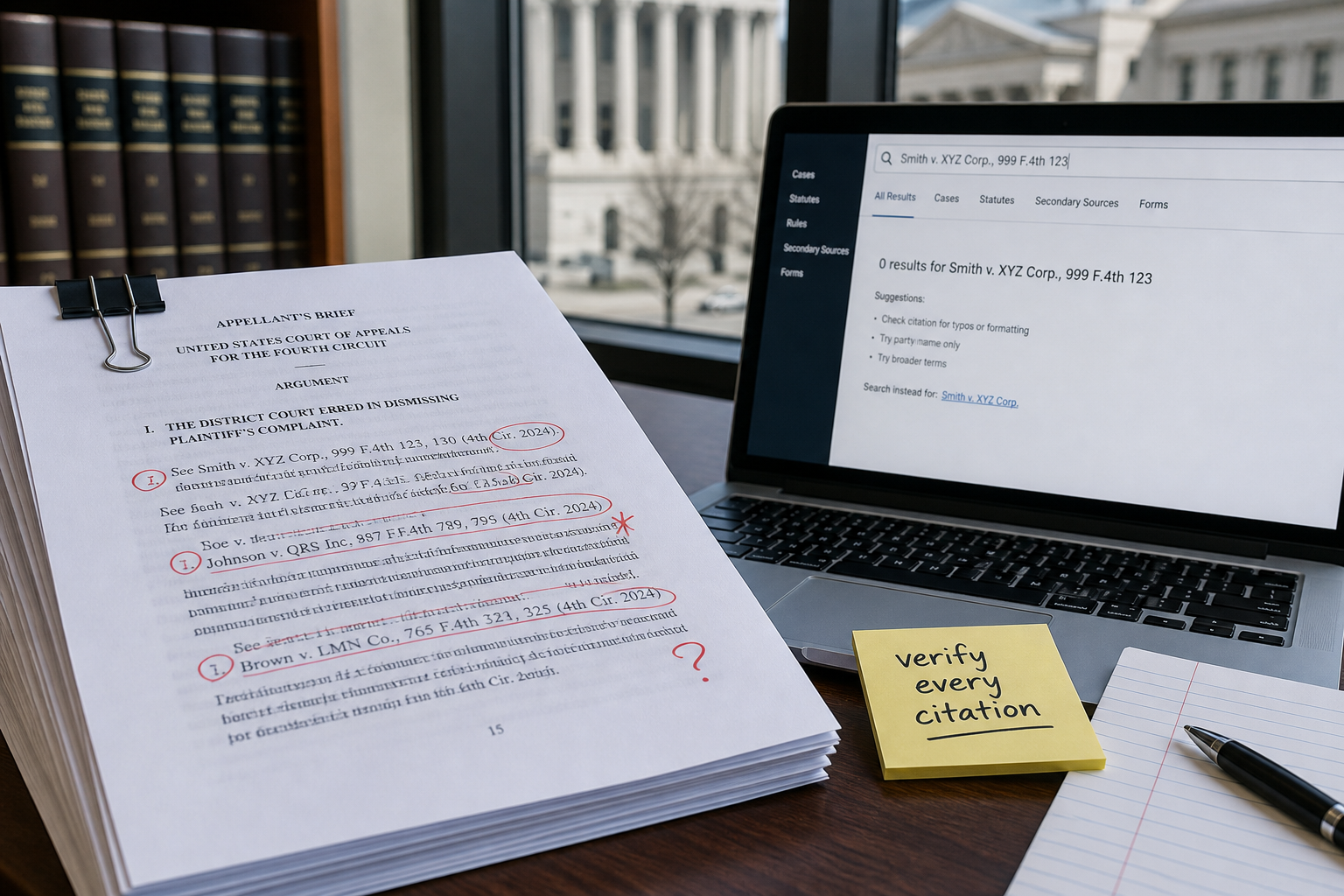
    In Kevin Leiske et al. v. Robert Gregory Kidd et al., Vice Chancellor Lori Will ordered Richard P. Rollo and Richards, Layton & Finger to show cause why they should not be sanctioned under Rule 11 and the court's inherent authority. The July 1 order says the answering brief contained fictitious citations, fabricated quotations, and hallucinated legal propositions. It also says the problems got worse after the errors were flagged.

    That makes this more than another fake-citation story.

    Why This Order Matters

    The Delaware opinion is not just about whether a lawyer used AI badly.

    It is about what a court wants to know after that happens:

    • who used the tool,
    • who entered the prompts,
    • how the output was incorporated,
    • who was supposed to verify it,
    • whether lawyers personally checked the authorities, and
    • what firm safeguards existed at the time.

    That is a more mature court response than a generic warning not to trust AI.

    The court is treating GenAI misuse as a workflow, supervision, and certification problem.

    What The Court Said Happened

    According to the order, the plaintiffs' January 22 answering brief contained false citations, fabricated quotations, and legal propositions that the cited authorities did not support.

    The next day, after the defendants flagged the problems, plaintiffs' counsel acknowledged that a generative AI tool had been used to revise the brief. Counsel admitted the citations were not verified before filing and attributed the lapse to a paralegal's review.

    That did not end the problem.

    The court said the corrected brief removed quotation marks around erroneous statements of law but did not fix the underlying inaccuracies. It also took a dim view of counsel's argument that opposing counsel should have met and conferred before alerting the court. Vice Chancellor Will wrote that there is nothing to negotiate when a filing presents false citations to a tribunal.

    That passage is worth remembering. Courts may expect parties to meet and confer over ordinary disputes. They are not likely to treat false authority in a filed brief as a routine discovery squabble.

    The Firm Is In It Too

    The sharpest part of the order may be the firm-level piece.

    Delaware Chancery Rule 11(c)(1) says that absent exceptional circumstances, a law firm must be held jointly responsible for Rule 11 violations committed by its partners, associates, or employees. Vice Chancellor Will said this incident may implicate the firm's training, supervision, and deployment of GenAI, so the firm must answer alongside the signatory.

    That is what makes the order especially useful for law firm leaders.

    Many AI discussions still drift toward individual blame: which lawyer signed, which associate drafted, which paralegal cite-checked, which tool hallucinated. This order looks past that first layer. It asks what policies, training, and safeguards the firm had in place before the filing was made.

    What The Court Wants Explained

    The show-cause order requires separate affidavits from the signatory lawyer and an authorized firm representative by July 15.

    For the lawyer, the court wants:

    • a timeline showing how and when the GenAI tool was used in drafting the brief;
    • who entered prompts and how the output was added to the filing;
    • a description of the cite-checking process before filing;
    • what instructions were given to paralegals;
    • what verification tools were used;
    • whether attorneys verified the cited text; and
    • why the corrected brief removed quotation marks but kept flawed legal propositions.

    For the firm, the court wants:

    • written GenAI policies, guidelines, and restrictions that were in effect at the time;
    • how those policies were communicated to the lawyers and staff involved;
    • what internal safeguards or training the firm has implemented or plans to implement; and
    • any claimed exceptional circumstances for avoiding joint responsibility.

    That is close to a court-issued AI governance checklist.

    What This Means For Firms Using AI

    The Delaware order does not hold that AI use in drafting is forbidden. In fact, Vice Chancellor Will repeated the now-familiar point that using GenAI in legal work is not inherently problematic if the output is carefully verified.

    The problem is that verification cannot be vague, delegated away, or assumed.

    If a court asks how an AI-assisted brief was produced, a firm should be ready to show more than a policy memo. It should be able to explain the actual workflow:

    • which tools were approved;
    • what legal and factual checks were required before filing;
    • whether the signing lawyer personally reviewed the sources;
    • how staff cite-checking fit into the process; and
    • what happens when an error is found after filing.

    That is where a lot of firms are still thinner than they think.

    Why This Is A Good Follow-On To The Recent Cases

    Clearon has already covered opinions focusing on false quotations, fabricated authorities, and verification failures in appellate and trial-court filings.

    The Delaware order adds a different layer. It is not just asking whether the brief was wrong. It is asking how the law firm's internal AI controls worked, and whether they worked at all.

    That makes it a strong Courts and AI story. It sits at the intersection of court sanctions doctrine, supervisory responsibility, and practical AI governance inside firms.

    Bottom Line

    The Delaware Court of Chancery has not imposed final sanctions in Leiske yet. But the July 1 show-cause order already says a lot.

    It says GenAI mistakes in a filed brief can become a Rule 11 problem. It says deleting quotation marks without fixing the legal proposition is not a real correction. And it says firms should expect courts to ask about policies, training, verification, and supervision when AI-assisted work goes wrong.

    That is the part worth watching.

    Sources

  • The Perplexity Publisher Cases Are Becoming a Real S.D.N.Y. Cluster

    The Perplexity Publisher Cases Are Becoming a Real S.D.N.Y. Cluster

    The Perplexity cases are no longer just one publisher dispute with a few echoes around it.

    The filings now show something more structured: repeated publisher plaintiffs, the same defendant, the same court, and relatedness filings that tie the newer suits back to the earlier ones.

    That is why the better way to read these cases now is as a real Southern District of New York cluster.

    This point is procedural before it is substantive. It does not tell us who will win. It does tell us that the Perplexity litigation map is getting denser in one court, and that matters on its own.

    The Short Answer

    • Perplexity is no longer facing just one major publisher case in S.D.N.Y.
    • Court filings now show a growing set of publisher actions in the same court, with relatedness filings linking newer cases to earlier ones.
    • That does not create formal consolidation by itself, but it does make the litigation easier to understand as a cluster rather than a series of isolated disputes.

    The Anchor Case Came First

    The best starting point is still Dow Jones & Company, Inc. v. Perplexity AI, Inc.

    That case put a major publisher plaintiff and Perplexity into S.D.N.Y. on a copyright-centered answer-engine theory. On its own, it could still have been treated as one important lawsuit against one AI company.

    That is no longer the full picture.

    The New York Times And Chicago Tribune Cases Changed The Shape

    In December 2025, two more publisher suits were filed against Perplexity in the same court.

    The New York Times Company v. Perplexity AI, Inc. was filed on December 5, 2025. The docket includes a statement of relatedness pointing back to Dow Jones & Company, Inc. v. Perplexity AI, Inc.

    Chicago Tribune Company, LLC v. Perplexity AI, Inc. was filed on December 4, 2025. That docket also includes a statement of relatedness pointing back to the Dow Jones action.

    Those filings matter because they show the cases were not framed as unrelated one-offs. From the start, the newer publisher complaints were being tied back to the earlier Perplexity case in the same court.

    CNN Makes The Cluster Harder To Ignore

    The pattern became even harder to miss when Cable News Network Inc. v. Perplexity AI, Inc. was filed on May 28, 2026.

    The CNN docket includes a statement of relatedness tying the case to The New York Times Company v. Perplexity AI, Inc. The docket also shows an earlier relatedness filing attempt referencing the Chicago Tribune matter.

    That is not just another headline plaintiff. It is another sign that the Perplexity publisher cases are being filed with one eye on the surrounding map.

    Why The Cluster Framing Matters

    Calling these cases a cluster is not just a visual convenience.

    It changes how the litigation should be watched.

    Once several publisher suits sit against the same defendant in the same court, a few practical questions become more important:

    • whether judges start treating the cases as part of one broader dispute landscape;
    • whether overlapping pleadings sharpen a common theory about answer-engine substitution or output-side competition;
    • whether procedural coordination pressure increases even without full consolidation;
    • whether discovery, motion practice, or settlement posture in one case starts influencing expectations in the others; and
    • whether additional publisher plaintiffs see S.D.N.Y. as the natural forum for similar claims against Perplexity.

    That does not require the cases to become one proceeding. The cluster effect can matter well before that.

    This Is Still Not A Merits Answer

    The cluster point should not be overstated.

    These dockets do not prove that the publishers' claims are right. They do not tell us whether Perplexity's defenses will succeed. They do not resolve how courts will draw lines between training issues, output issues, substitution theories, trademark theories, or fair-use arguments.

    They do show something narrower and still important.

    Perplexity is no longer dealing with a single flagship publisher suit in isolation. It is dealing with a growing publisher map in one federal court.

    That is a meaningful litigation development even before any decisive merits ruling arrives.

    The Useful Question Now Is What Repeats

    For Clearon readers, the most useful next step is to watch for repetition across the Perplexity dockets.

    The more the same themes repeat, the more clearly this becomes a real litigation category rather than a collection of separate complaints.

    The questions to track are straightforward:

    • Which claims appear across multiple publisher cases?
    • How often do plaintiffs frame Perplexity as a substitute for original publisher content rather than just a training-data user?
    • Do the pleadings keep centering answer-engine behavior, branding, or output presentation?
    • Does S.D.N.Y. begin to look like the home court for this publisher-versus-answer-engine fight?

    Those repetition points may become more informative than any single complaint standing alone.

    Bottom Line

    The Perplexity publisher cases are becoming a real S.D.N.Y. cluster because the filings now show repeated publisher plaintiffs, repeated relatedness filings, and repeated use of the same court.

    That does not answer the merits. It does answer something else that matters right now.

    Perplexity is facing a denser and more legible publisher-litigation map than it was a few months ago. For anyone tracking AI litigation, that is already a story worth treating as its own development.

    Sources

  • FTC’s Companion Chatbot Inquiry Shows What Companies Need to Be Ready to Produce

    FTC’s Companion Chatbot Inquiry Shows What Companies Need to Be Ready to Produce

    The FTC’s companion chatbot inquiry is not a complaint, a consent order, or a liability finding.

    It is still one of the clearest official documents on what the agency wants to see when it starts asking questions about companion-style AI products.

    That is the part companies should pay attention to.

    The Commission used its 6(b) authority to order seven companies offering consumer-facing AI chatbots or companion-style services to provide special reports. The FTC said it wanted information on how those firms measure, test, and monitor potentially negative impacts on children and teens.

    A lot of AI companies still talk about companion safety as a content-moderation problem or a product-policy problem. The FTC’s order structure treats it as something larger: a records problem, a testing problem, a monetization problem, and a governance problem.

    The Short Answer

    • The FTC’s 6(b) inquiry is an information demand, not an enforcement action or a final liability conclusion.
    • The inquiry still matters because it shows what the agency thinks companies should be able to explain about companion-chatbot safety, youth harms, disclosures, monetization, and data handling.
    • The practical warning is simple: if a company cannot produce a coherent file on how its companion product was designed, tested, monitored, and marketed, it may already be in trouble before any complaint is filed.

    Why The 6(b) Tool Matters

    Section 6(b) of the FTC Act lets the Commission require companies to file special reports and answer questions about their business practices.

    That matters because a 6(b) order is not limited to one narrow incident. It is a way for the FTC to map a market, compare company practices, and decide where enforcement or rulemaking pressure may go next.

    For companion chatbots, that means the FTC is not only asking whether one system produced one bad output.

    It is asking broader questions:

    • what risks companies already knew about,
    • what they tested for,
    • what safety controls they chose,
    • how engagement incentives work,
    • what users and parents were told, and
    • how sensitive conversational data is handled.

    That is a much more operational inquiry than a headline about "AI harms children."

    What The FTC Asked About

    The Commission’s public description of the inquiry is revealing on its own.

    The FTC said companion chatbots can mimic human characteristics, emotions, and intentions, and may prompt some users, especially children and teens, to trust and form relationships with them.

    The inquiry asks about:

    • how companies measure, test, and monitor potentially negative impacts on children and teens;
    • how user engagement is monetized;
    • how user inputs and outputs are processed;
    • how chatbot characters are created, reviewed, and approved;
    • what pre-deployment and post-deployment testing occurred;
    • what mitigation steps were used for known harms;
    • what disclosures were given to users and parents;
    • how age restrictions and community rules are enforced; and
    • how personal information from chatbot conversations is used or shared.

    That is not a generic safety questionnaire. It is a map of what the FTC thinks a serious companion-chatbot governance file should contain.

    The Inquiry Turns Product Design Into A Records Question

    A lot of consumer AI companies still rely on high-level safety claims.

    They say the product is supportive, carefully moderated, intended for healthy use, not designed for minors, or backed by trust and safety controls.

    The FTC’s inquiry points to the next question after those claims: what can the company prove?

    Can it show:

    • what youth-risk scenarios were tested;
    • what self-harm or dependency concerns were raised internally;
    • what escalation pathways exist for dangerous conversations;
    • what guardrails were added before launch and after incidents;
    • what engagement mechanics may reward longer or more emotionally intense sessions; and
    • what records support public claims about safety and responsible design?

    That is why the inquiry matters even without an enforcement complaint. It shows the level of detail the agency may expect if a product becomes the subject of later scrutiny.

    Monetization Is Part Of The Safety Analysis

    One of the most important FTC signals here is that monetization is not separate from safety.

    If a companion product makes money from time spent, subscriptions tied to emotional engagement, premium relationship features, or repeated return sessions, regulators may ask whether those incentives increase foreseeable harm.

    That does not mean every subscription model is unlawful.

    It does mean companies should expect questions about whether product incentives reward:

    • deeper emotional reliance,
    • longer sessions for vulnerable users,
    • repeated return behavior after distress,
    • higher-risk roleplay or intimate interaction, or
    • weaker intervention when a user shows signs of crisis.

    Once monetization is linked to emotional engagement, the business model itself becomes part of the risk analysis.

    Data Handling Is In The Same File

    The FTC also tied the inquiry to data practices.

    That matters because companion products often handle unusually sensitive material: loneliness, mental health, sexuality, family conflict, grief, self-harm, identity questions, and other intimate conversation topics.

    The regulatory question is not only whether the company collected that information.

    It is also:

    • how long it kept it,
    • whether it used it for product training or character tuning,
    • whether it shared it internally or externally,
    • what users understood about that use, and
    • whether minors’ data received different treatment.

    For companion systems, safety review and data-governance review should not live in separate silos. The FTC is clearly looking at both at once.

    This Fits The Broader Companion-Chatbot Pattern

    The FTC inquiry is one lane in a broader pattern Clearon has already been tracking.

    New York, California, and Oregon have now enacted companion-chatbot requirements focused on nonhuman disclosures, youth-facing safeguards, and self-harm response protocols. Oregon’s chaptered SB 1546 adds another state example of disclosure duties and a private enforcement hook. Florida’s lawsuit against OpenAI shows how a state attorney general may try to turn chatbot design, minors, warnings, and data practices into a broader consumer-protection case.

    The FTC inquiry fits that same trend, but from a federal document-demand angle.

    The common question is not simply "did the chatbot say something bad?"

    It is "what did the company know, what did it build, what did it test, what did it tell users, and what records support those answers?"

    What Companies Should Do Now

    Companies offering companion or emotionally responsive chatbots should treat the inquiry as a checklist.

    At minimum, they should be able to locate:

    • product definitions showing whether the system fits a companion or relationship-like use case;
    • youth-risk and self-harm testing materials;
    • character-design review records;
    • disclosure language for users and parents;
    • age-gating and age-estimation policies;
    • incident logs and escalation records;
    • monetization documents tied to engagement design;
    • moderation and crisis-intervention protocols;
    • data-retention and data-sharing rules for sensitive conversations; and
    • internal support for public safety and trust claims.

    The point is not to generate paperwork for its own sake.

    The point is that if the FTC asks for the file, the company should not need to reconstruct its safety story from scattered chat threads, slide decks, and product meetings.

    Bottom Line

    The FTC’s companion chatbot inquiry is not an enforcement result. It is a preview of the agency’s questions.

    Those questions are practical and specific. They center on youth harms, testing, character design, disclosures, monetization, moderation, and data handling.

    For companies building companion-style AI, that is the warning. The compliance issue is no longer only what the product says to users. It is whether the company can produce a credible record of how the product was built, reviewed, and governed before regulators ask for it.

    Sources

  • California May Turn AI Guidance for Lawyers Into Formal Conduct Rules

    California May Turn AI Guidance for Lawyers Into Formal Conduct Rules

    California's State Bar is doing more than repeating familiar AI guidance for lawyers.

    It has proposed amendments to the Rules of Professional Conduct that show what lawyer-AI obligations can look like when a major bar starts moving from guidance into rule text.

    That is the part worth watching.

    The archived public-comment materials show a proposal developed after the California Supreme Court asked the State Bar to consider how its 2023 generative-AI guidance, and newer agentic-AI issues, might be incorporated into the Rules of Professional Conduct. The public comment period listed on the archived page has already closed. The bigger point remains: the proposal gives one of the clearest official previews of how AI obligations for lawyers may harden into enforceable discipline rules.

    The Short Answer

    • California has not adopted binding AI conduct rules for lawyers yet.
    • The State Bar's proposal still matters because it shows how AI issues may be written into core professional-duty rules instead of left in advisory guidance.
    • The proposal's focus areas are the ones lawyers should expect everywhere: competence, confidentiality, client communication, candor, supervision, and verification of AI-generated legal authority.

    Why This Matters Beyond California

    Most lawyer-AI guidance so far has followed a familiar pattern.

    Bars, courts, and ethics bodies issue practical reminders: understand the tool, protect confidentiality, verify citations, supervise staff, and tell clients enough about material AI use.

    That guidance matters. It still leaves room for firms to treat AI governance as a policy issue rather than a disciplinary issue.

    The California proposal is different because it points toward actual rule text.

    Once AI expectations are folded into professional-conduct rules, the discussion changes. The question is no longer only whether a lawyer followed emerging practice guidance. It becomes whether the lawyer violated a binding duty that can support discipline, disqualification fights, client disputes, malpractice claims, or sanctions arguments.

    That is why this proposal deserves attention outside California too.

    What The Proposal Covers

    The State Bar materials describe proposed amendments tied to core lawyer duties affected by artificial intelligence.

    The tracked proposal topics include:

    • competence,
    • confidentiality,
    • client communication,
    • candor,
    • supervision, and
    • verification of AI-generated legal authority.

    That list matters because it avoids the mistake of treating AI as one standalone issue.

    Instead, it treats AI as something that cuts across the duties lawyers already owe.

    The practical message is plain. A lawyer does not get a separate, lower standard because a problem came from an AI tool instead of an associate, vendor, paralegal, or research database.

    The Verification Point Is The Sharpest One

    The most concrete signal in the proposal is the emphasis on verification of AI-generated legal authority.

    That fits the wider court pattern Clearon has been tracking. Judges are not only reacting to imaginary cases anymore. They are reacting to false quotations, misdescribed holdings, unsupported propositions, and filings that reached the docket without real source checking.

    California's proposal matters because it shows how that concern could migrate from scattered sanctions opinions into an express professional-conduct framework.

    For firms and lawyers, the lesson is direct: citation verification is becoming part of AI governance, and AI governance is moving toward core ethics obligations.

    Confidentiality And Client Communication Are Next

    The proposal also matters because it recognizes that AI risk for lawyers is not only about bad citations.

    Confidentiality questions turn on what tool is used, what data goes into it, what contractual or technical protections exist, and whether the workflow changes the privilege or work-product analysis. Client-communication questions turn on whether AI use is material to the representation, whether a client should be told, and whether the lawyer can accurately explain the benefits and limits of the system being used.

    Those are not abstract issues anymore. They already appear in litigation, discovery disputes, and protective-order fights.

    The California proposal suggests that bars may start treating those decisions less as optional internal policy choices and more as components of ordinary professional responsibility.

    Supervision Does Not Stop At The Tool

    Another reason this proposal matters is supervision.

    AI use in legal practice often sits in the middle of a chain:

    • a vendor builds the tool,
    • a firm or department approves it,
    • staff or junior lawyers use it,
    • and a signing lawyer adopts the output.

    The supervision question is where responsibility lands when that chain breaks.

    Courts have already answered part of it. The signing lawyer remains responsible for the filing or work product that reaches the client or tribunal.

    The California proposal appears to push in the same direction. AI does not dissolve supervisory responsibility. It raises the need for it.

    This Is Still A Proposal

    The proposal should not be overstated.

    The archived State Bar page reflects proposed amendments for public comment, not adopted California Supreme Court rules. The comment deadline listed on the page has already passed. As of this article's publication, the tracked issue is the proposal itself and what it signals, not a final adopted rules package.

    That distinction matters. Lawyers should not describe these provisions as current binding California ethics rules unless and until they are formally adopted.

    Still, the proposal is important because it shows the direction of travel. It is a preview of how one major bar is thinking about turning AI guidance into enforceable conduct rules.

    What Lawyers Should Do Now

    Lawyers and firms do not need to wait for final California action to act on the proposal's logic.

    They should already be able to answer:

    • which AI tools are approved for legal work;
    • what information may or may not be entered into them;
    • who verifies citations, quotations, legal propositions, and record references;
    • when client disclosure about AI use is required or recommended;
    • how AI-assisted work by staff and contract lawyers is supervised;
    • how incident escalation works when an AI-generated error is found; and
    • what records show that these controls were actually followed.

    If the firm cannot answer those questions clearly, it is not ready for a world where bar regulators start reading AI use through standard professional-duty rules.

    Bottom Line

    California's State Bar has not adopted binding AI rules for lawyers yet. It has done something close to the next most important thing: it has shown what those rules may look like.

    The proposal treats AI as a competence, confidentiality, client-communication, candor, supervision, and verification problem. That is a more serious frame than generic reminders to be careful with AI.

    For lawyers, the message is simple. The safest assumption is that AI governance is moving toward ordinary professional responsibility, not away from it.

    Sources

  • DOJ and xAI Turn Colorado’s AI Law Into a Federal Constitutional Fight

    DOJ and xAI Turn Colorado’s AI Law Into a Federal Constitutional Fight

    Colorado’s AI law is no longer only a compliance project.

    It is also becoming one of the first serious constitutional test cases for a state AI statute.

    xAI sued Colorado over the state’s algorithmic-discrimination framework. Then the U.S. Department of Justice intervened on xAI’s side. Meanwhile, the Colorado Attorney General opened pre-rulemaking on the state’s revised ADMT law and related chatbot legislation.

    That combination matters because it puts three different pressures on the same legal framework at once:

    • compliance design,
    • rulemaking detail, and
    • constitutional attack.

    For companies that may be covered by Colorado’s law, the practical problem is not just what the statute says on paper. It is what survives litigation, what gets clarified in rulemaking, and what obligations companies may need to build toward while the fight is still unresolved.

    The Short Answer

    • xAI’s case is a constitutional challenge to Colorado’s algorithmic-discrimination framework, not a ruling that the law is invalid.
    • DOJ’s intervention matters because it turns the case from a private company challenge into a federal-backed attack on the state’s theory.
    • The case is procedurally important even before a merits ruling because enforcement was stayed pending the forthcoming preliminary-injunction sequence tied to final rulemaking.

    What xAI Is Challenging

    The Clearinghouse summary describes the case as a challenge to Colorado’s law regulating high-risk AI systems and requiring reasonable care to prevent so-called algorithmic discrimination against protected groups.

    According to the Clearinghouse summary, xAI filed suit in April 2026 and asserted multiple constitutional claims, including theories under the First Amendment, Commerce Clause, Due Process Clause, and Equal Protection Clause.

    The core political and legal complaint is familiar by now. xAI argues that Colorado’s framework does not simply prohibit unlawful discrimination. It pressures AI developers and deployers to adjust systems around demographic outcomes and, in xAI’s view, embeds a race-conscious and ideologically loaded compliance model.

    That does not mean xAI is right on the merits. It does mean the fight is not a narrow technical dispute about one reporting field or one definition.

    It is a broad challenge to whether a state can regulate algorithmic discrimination in a way that requires ongoing risk monitoring, compliance controls, and corrective action without crossing constitutional lines.

    Why DOJ’s Intervention Matters

    The DOJ press release is the signal that makes this more than an ordinary private challenge.

    DOJ said it intervened in xAI’s lawsuit challenging Colorado’s algorithmic-discrimination requirements. The department’s position, as described in its announcement, is that the law violates the Equal Protection Clause by requiring companies to prevent unintentional disparate impact based on protected characteristics while exempting some discrimination aimed at increasing diversity or redressing historical discrimination.

    That is not a final court holding. It is DOJ’s theory.

    But DOJ participation changes the weight of the case in two ways.

    First, it increases the chance that the litigation will be treated as a national policy fight, not just a Colorado-specific dispute.

    Second, it gives other states and regulated companies a clearer preview of the arguments likely to be made against future state AI discrimination statutes.

    If a state wants to regulate discriminatory AI outcomes, this is the line of attack it should now expect:

    • the law is too vague,
    • the law pressures companies into demographic calibration,
    • the law burdens speech or model design,
    • the law disrupts interstate commerce, or
    • the law uses protected-characteristic logic in a way that creates its own constitutional problem.

    Even if some of those theories fail, they are now part of the real operating environment for state AI law.

    The Stay Matters More Than It Sounds

    One of the most practical parts of the case is procedural.

    The Clearinghouse docket summary and docket entries show that the court granted a joint motion staying enforcement by the Colorado Attorney General for alleged violations of SB24-205, or any replacing or amending legislation from that session, occurring on or before 14 days after a ruling on xAI’s forthcoming preliminary-injunction motion.

    The same order tied xAI’s preliminary-injunction motion deadline to the final adoption of implementing rulemaking.

    That is a big deal.

    It means the rulemaking is not happening off to the side while litigation proceeds independently. The final implementing rules are part of the path toward the preliminary-injunction fight.

    So the rulemaking record may influence:

    • how burdensome the law appears,
    • how concrete or vague the obligations look,
    • whether the court sees the law as manageable or indeterminate, and
    • how sharply the constitutional arguments land.

    That is why companies should not assume the stay makes Colorado irrelevant for now. It may make the current rulemaking stage even more important.

    This Is Bigger Than One Colorado Statute

    The broader significance is not just Colorado.

    State lawmakers, attorneys general, and privacy or civil-rights regulators have been experimenting with different ways to govern AI discrimination, consequential decision systems, explainability, review rights, and chatbot safeguards.

    Colorado is one of the first places where those ideas are being tested all at once:

    • a live statute,
    • live pre-rulemaking,
    • a live constitutional challenge, and
    • direct federal intervention.

    That makes the case useful even for companies outside Colorado.

    If a court eventually narrows or blocks core parts of the Colorado regime, other states may rewrite future AI laws differently. If Colorado survives the attack, that may embolden other states to move faster with similar frameworks.

    Either way, the litigation is helping define the limits of state AI governance.

    What Companies Should Do Now

    Companies should avoid two bad instincts.

    The first is panic. There is no merits ruling yet, and the current fight does not mean every algorithmic-discrimination law will collapse.

    The second is complacency. The stay does not mean the underlying compliance and governance questions disappeared.

    A useful response now includes:

    • mapping which systems may materially influence consequential decisions;
    • separating developer and deployer roles across the AI supply chain;
    • tracking Colorado’s final rulemaking closely;
    • reviewing whether current governance depends on outcome monitoring tied to protected characteristics;
    • pressure-testing documentation, notice, review, and adverse-outcome workflows; and
    • watching how constitutional objections may affect future state-law design in other jurisdictions.

    For companies likely to operate under more than one emerging state AI framework, the real question is no longer just "what does Colorado require?"

    It is also "which parts of this model are likely to survive?"

    Bottom Line

    DOJ and xAI are turning Colorado’s AI law into an early constitutional test case for state AI governance.

    The result is not in yet. But the structure of the dispute is already clear.

    Colorado is trying to operationalize AI discrimination rules through legislation and rulemaking. xAI is trying to stop that framework on constitutional grounds. DOJ is now backing part of that attack. And the court has linked the enforcement and preliminary-injunction timeline to final rulemaking.

    That makes Colorado one of the most important places to watch if you want to understand what state AI law may look like after the first serious round of litigation.

    Sources

  • What Companies Should Do When AI Rules Are Fragmented Across States, Agencies, and Courts

    What Companies Should Do When AI Rules Are Fragmented Across States, Agencies, and Courts

    A lot of companies are still waiting for AI law to become neat.

    They want one federal statute, one regulatory framework, one court doctrine, and one checklist that settles the problem.

    That is not the environment they have.

    The real operating environment is fragmented across states, agencies, courts, sector rules, contract demands, and product-specific risk.

    That fragmentation is frustrating. It is also manageable if companies stop treating AI compliance as a search for one master rule and start treating it as a workflow problem.

    The Short Answer

    • AI law is fragmenting across multiple legal systems at once: state consumer-protection law, federal agency action, court decisions, sector-specific rules, and non-U.S. frameworks.
    • Companies that wait for one unified AI rulebook may fall behind the actual risk.
    • The practical response is not to memorize every rule. It is to build a repeatable intake, classification, review, documentation, and escalation process that can absorb changing legal inputs.

    The Real Problem Is Not Just Volume

    Most companies describe the issue as too many AI rules.

    That is true, but incomplete.

    The harder problem is that the rules are coming from different places and asking different kinds of questions.

    One state may focus on automated decision-making and bias risk.

    Another may focus on chatbot safety, youth access, or emotionally manipulative design.

    The FTC may focus on deception, hidden model steering, or unsupported accuracy claims.

    State attorneys general may focus on product design, vulnerable users, and public-facing marketing.

    Courts may focus on sanctions, privilege, work product, or protective-order restrictions.

    The EU may focus on transparency, labeling, governance, and deployer obligations.

    Patent offices may focus on inventorship and filing practices.

    This is not one compliance lane. It is a stack of overlapping ones.

    The Wrong Response Is To Build A Law List Without A Workflow

    A lot of organizations react by creating a giant AI law tracker and then stopping there.

    Tracking is necessary. It is not enough.

    A list of developments does not tell the company:

    • which products are in scope;
    • which claims matter most;
    • which teams own the response;
    • when an issue should escalate to legal;
    • what documentation should be preserved;
    • how vendor risk connects to product risk; or
    • what happens when two legal signals point in different directions.

    That is why companies with impressive issue tracking can still be weak operationally.

    They know what changed. They do not have a consistent way to act on it.

    Fragmentation Usually Shows Up In Five Operational Problems

    1. No Clear AI Intake Function

    Many organizations still do not have one reliable way for teams to flag:

    • a new AI product feature;
    • a vendor purchase;
    • a model change;
    • a high-risk use case;
    • a public marketing claim;
    • or a new jurisdictional issue.

    Without intake, the company never gets a clean first look at what needs review.

    2. No Risk Tiering

    Not every AI use case needs the same level of scrutiny.

    An internal summarization tool is not the same as a public-facing chatbot for teenagers. A marketing-assist tool is not the same as an automated HR workflow. A contract-analysis system is not the same as a medical advice assistant.

    If the company does not tier AI uses by risk, it will either over-review low-risk tools or under-review the ones that matter most.

    3. No Cross-Functional Owner

    Fragmented law creates fragmented internal ownership unless someone is responsible for pulling the pieces together.

    Legal may track statutes. Privacy may track data use. Security may track model exposure. Product may control deployment. Marketing may control claims. Procurement may control vendor intake.

    That structure is normal. It still needs a coordination point.

    Otherwise the legal risk lives in the gaps between teams.

    4. Weak Documentation

    Fragmented law increases the need for records because the company may later need to explain:

    • why a system was classified one way instead of another;
    • why a disclosure was used;
    • why a vendor was approved;
    • why a feature launched despite known limitations; or
    • why one jurisdictional rule was treated as controlling.

    If those judgments are not documented, later review becomes much harder.

    5. Overreliance On Vendor Assurances

    Many AI compliance gaps start with vendor language.

    A vendor says its product is compliant, enterprise safe, explainable, unbiased, privacy preserving, or ready for regulated use. The buyer takes that statement at face value because the vendor sounds sophisticated and the market is moving fast.

    That is dangerous in a fragmented legal environment because the buyer may still bear downstream risk even when the vendor caused the original representation problem.

    The Better Approach Is A Governance Workflow

    Companies do not need a perfect unified AI law map before they can act.

    They need a usable governance workflow.

    That workflow should do at least six things.

    1. Create One AI Intake Path

    There should be one standard route for teams to raise:

    • new AI features;
    • material model changes;
    • new vendors;
    • sensitive use cases;
    • customer requests involving AI claims or commitments; and
    • incidents or complaints tied to AI outputs.

    The key is consistency, not bureaucracy.

    2. Classify The Use Case

    Every material AI use should be classified by factors such as:

    • internal or external use;
    • consumer-facing or enterprise-facing;
    • use by minors or vulnerable users;
    • impact on employment, health, finance, education, housing, or legal rights;
    • use of sensitive data;
    • degree of autonomy;
    • marketing sensitivity; and
    • jurisdictional footprint.

    This helps decide which legal lanes matter most.

    3. Tie Review To Risk, Not Buzzwords

    Legal review should not be triggered only because something is labeled AI.

    It should be triggered by what the system actually does, what data it touches, what claims are being made, and what decisions may flow from it.

    That keeps the review grounded in real exposure instead of branding alone.

    4. Preserve The Decision Record

    For material deployments, companies should preserve:

    • what the tool or feature was meant to do;
    • what risks were identified;
    • what testing occurred;
    • what mitigations were added;
    • what claims were approved;
    • which jurisdictions or legal frameworks were considered; and
    • who approved the decision.

    That record becomes valuable fast if the system is later challenged.

    5. Review Public And Customer-Facing Claims Separately

    A lot of AI risk is created not by the technical system itself but by the way the system is described.

    Claims about safety, objectivity, transparency, compliance, age appropriateness, human oversight, and accuracy should get their own pass, not just a product review pass.

    6. Build An Escalation Rule

    Some AI issues should escalate automatically.

    For example:

    • systems affecting minors or vulnerable users;
    • high-impact decision systems;
    • products using sensitive personal data;
    • systems marketed as safe, objective, or compliant;
    • incidents involving self-harm, dangerous instructions, or severe output failure;
    • and any state, agency, or court demand tied to AI conduct.

    Companies do not need to improvise those escalation rules in the middle of a problem.

    What Companies Should Do Now

    If the company is already feeling the fragmentation problem, the most useful next steps are practical:

    • create one intake form or intake workflow for material AI uses and changes;
    • define a small number of AI risk tiers instead of trying to classify everything from scratch each time;
    • assign one cross-functional owner or review group for material AI decisions;
    • inventory current public claims about AI safety, accuracy, oversight, and compliance;
    • map which jurisdictions and agency frameworks matter most for the company's actual products;
    • review vendor AI questionnaires and procurement language for overpromising;
    • create an escalation trigger list for high-risk AI incidents and launches; and
    • make sure review decisions are being saved somewhere retrievable.

    This will not eliminate legal fragmentation.

    It will make the company much better at operating inside it.

    Bottom Line

    AI rules are fragmented across states, agencies, courts, sectors, and jurisdictions. That is not a temporary drafting glitch. It is the real operating environment right now.

    The companies that handle it best will not be the ones waiting for a clean universal AI rulebook.

    They will be the ones that build a workable compliance process around intake, classification, review, documentation, and escalation.

    Fragmented law is annoying. Fragmented internal workflow is what turns it into a real problem.

    Sources

  • Why AI-Washing Risk Is Becoming a Real Legal Category

    Why AI-Washing Risk Is Becoming a Real Legal Category

    For a while, AI washing sounded like a cheap shot. A company slapped “AI-powered” on ordinary software. A vendor implied the model could do more than it really could. A marketing team reached for the label because the market wanted to hear it.

    That still happens. What has changed is the legal posture around it.

    AI washing is no longer just a hype problem. It is turning into a substantiation problem. When a company says a product is intelligent, autonomous, safe, accurate, compliant, unbiased, or ready for sensitive work, regulators, customers, investors, and plaintiffs can all ask the same question: what did that claim actually mean, and what evidence supported it?

    That question does not require a new AI-specific statute. Existing deception, unfairness, privacy, procurement, securities, and misrepresentation theories are already enough to create pressure.

    Why This Is Becoming A Real Legal Category

    The reason is straightforward. AI claims now shape material decisions.

    Consumers may rely on them when deciding whether a product is safe, trustworthy, educational, therapeutic, or appropriate for minors. Enterprise buyers may rely on them when deciding whether a system is ready for legal, HR, health, finance, or security workflows. Investors and board members may rely on them when evaluating growth, defensibility, product moat, or operational maturity.

    Once AI language starts influencing those decisions, the claim stops being casual branding. It becomes something closer to a factual representation about capability, safety, governance, or reliability.

    That is why AI washing is becoming a legal category even without a statute labeled “AI washing.” The law already knows how to handle claims that create a misleading net impression.

    “AI” Is Not Just One Claim

    One reason this gets messy fast is that companies often use AI language as if it were a single label.

    It is not. Saying a product uses AI can imply very different things depending on the context. It may suggest the product actually uses machine learning rather than ordinary automation. It may suggest the system is more advanced than a rules engine, improves itself over time, requires less human labor, produces more accurate results, acts autonomously, or has stronger safety and governance controls than competing tools.

    Those are not all the same claim. They create different expectations and different legal exposure.

    A regulator or plaintiff usually does not need to prove that every part of the AI story was false. It is often enough to show that the overall impression was materially misleading for the audience that mattered.

    The Problem Is Broader Than Capability Hype

    The obvious form of AI washing is capability inflation. A company says the product can do things it cannot do.

    The harder cases are broader than that. The claim may not be “our model is magic.” It may be “our system is safe,” “our outputs are objective,” “our workflow is compliant,” “our AI runs with human oversight,” or “our platform is enterprise ready.”

    That is where the risk gets more serious, because those claims are often tied to internal process, governance, testing, escalation, data handling, and product design, not just model performance.

    A company can also create AI-washing risk by hiding the amount of human labor behind the product, downplaying model limitations, overstating bias mitigation, overstating explainability, or suggesting a level of operational control that does not really exist.

    In other words, the legal problem is often not “you said the word AI.” It is “you used AI language to imply a level of performance, safety, or governance that the record cannot support.”

    The FTC Makes The Trend Easier To See

    The FTC's proposed AI accuracy policy statement is not an anti-AI-washing rule by name, but it shows the direction clearly.

    The Commission's point is that a company may create the impression that its AI system is trying to provide the best, most accurate, or most truthful answer for the user's objective. If the system is actually steered toward a different hidden objective, the FTC says that may be deceptive.

    That is a model-design issue, but it is also a claims issue. A company may never use the phrase “objective and neutral” and still create that impression through product design, benchmarking language, sales materials, accuracy messaging, or positioning.

    The same pattern showed up differently in the FTC's Active Listening matter. There, the problem was not just a buzzword. It was the gap between what the product was presented as doing and what the facts supported about the listening function and the related privacy implications.

    Put those together and the pattern becomes clearer. AI-washing risk is not confined to inflated tech language. It can arise whenever the public story about the system outruns the product reality.

    Where The Risk Usually Shows Up

    The public homepage is only one part of the problem.

    Marketing copy is the obvious starting point because words like autonomous, safe, trustworthy, accurate, unbiased, transparent, and enterprise ready can imply a lot more than the company intends. Those words are not off-limits. They just need support.

    The bigger risk often sits in enterprise sales materials, procurement responses, security questionnaires, governance decks, and customer demos. That is where companies make concrete statements about explainability, retention, deletion, human review, model change management, data isolation, safety controls, and compliance readiness. If those statements outrun the actual workflow, the mismatch may surface later in a customer dispute, regulator inquiry, or internal escalation.

    Investor and board communications create another layer. If a company ties AI to measurable gains in safety, efficiency, margins, market position, or defensibility, those statements may later be compared against testing records, incident logs, and internal discussions. Not every optimistic statement creates liability. But specific, repeated, safety-linked claims deserve careful treatment.

    The product experience itself also matters. A system can create strong expectations without saying much at all. A chatbot that speaks with confidence, appears emotionally perceptive, presents itself as a trusted helper, or hides the extent of human involvement may create a stronger impression than any disclaimer in the footer.

    The Internal Record Usually Decides How Bad It Gets

    AI washing tends to look worst once someone asks for the internal record.

    If the company publicly describes a system as safe, accurate, objective, well-governed, or ready for sensitive deployment, the next questions are predictable. What testing supported that statement? What limitations were already known? Were complaints or incidents pointing in the other direction? Did anyone inside the company describe the claim as too aggressive? Was the claim approved because it was supported, or because it sounded good?

    That is the point where puffery arguments start to weaken. The problem stops looking like enthusiastic copy and starts looking like a documentation and governance failure.

    What Companies Should Review Now

    Companies using AI language in public or customer-facing materials should review a few things immediately.

    • Whether the claim is really about the presence of AI, or about performance, safety, autonomy, neutrality, or compliance.
    • Whether current product testing and governance records actually support the claim being made.
    • Whether consumers, enterprise customers, investors, and regulators are hearing different versions of the same product story.
    • Whether the product experience creates stronger expectations than the formal copy.
    • Whether disclaimers change the net impression in a meaningful way, or just try to patch over an aggressive claim after the fact.
    • Whether the rationale behind sensitive AI claims is being preserved in a way the company could defend later.

    The practical question is not “can we argue about this phrase if challenged?” It is “what expectation does this create, and would we be comfortable defending that expectation with the actual record?”

    Bottom Line

    AI washing is becoming a real legal category because AI claims now influence decisions about safety, trust, spending, and risk.

    The law does not need a special AI-washing label to get there. Existing doctrines already give regulators and plaintiffs room to test whether the public AI story matches the product, the workflow, and the record behind it.

    If a company would be uneasy putting its public AI claims next to its testing history, governance records, customer complaints, and known limitations, those claims probably need work.

    Sources

  • AI Litigation Is Increasingly About Governance Records

    AI Litigation Is Increasingly About Governance Records

    For a while, AI legal risk was often framed as a debate about big theories.

    Would copyright claims survive? Would Section 230 matter? Would a new AI statute appear? Would courts treat models as products?

    Those questions still matter. They are no longer the whole story.

    The more immediate litigation and enforcement risk is becoming much more operational. Regulators, state attorneys general, and private plaintiffs increasingly want to know what the company knew, what it tested, what it changed, what it told users, and what records support those answers.

    That is why AI litigation is increasingly about governance records.

    The Short Answer

    • AI legal risk is moving from abstract policy debate into record-based disputes about testing, warnings, internal knowledge, and product governance.
    • Plaintiffs and regulators are using existing consumer-protection, privacy, product-design, and safety theories to ask for concrete documents rather than broad philosophical answers.
    • Companies that cannot produce a coherent record of AI design, review, escalation, and mitigation may look irresponsible even before a court decides the merits.

    The Record Problem Is Showing Up Across Different AI Disputes

    The same pattern is emerging in several different legal lanes.

    Florida's lawsuit against OpenAI is not just about a chatbot existing in the market. The complaint tries to turn product design, youth access, safety controls, warnings, and data practices into evidence-backed state consumer-protection and product-liability questions.

    The reported 42-state OpenAI investigation appears to be asking for information about advertising, engagement, retention, sycophancy, vulnerable users, and treatment of sensitive data. Even at the investigation stage, that is a document-heavy inquiry.

    The FTC's proposed AI accuracy policy statement points in the same direction. If the agency believes a model is being steered away from the user's expected objective, the obvious next question is what internal records show about the product's actual objective, controls, and consumer-facing explanation.

    Companion-chatbot scrutiny also fits the pattern. Once a regulator or plaintiff argues that a system creates foreseeable emotional or behavioral risk, the practical fight becomes whether the company had warnings, testing, age controls, escalation rules, and internal evidence supporting its safety claims.

    These are different legal theories. They are all becoming record fights.

    The New Core Question Is “What Can The Company Prove?”

    That question matters because a lot of AI governance still lives in presentation decks, launch reviews, and broad principles rather than in disciplined operational records.

    A company may say it prioritizes safety, fairness, accuracy, trust, youth protection, or responsible AI use. In litigation, those statements are only the beginning.

    The harder questions look like this:

    • What testing was performed before release?
    • What failure modes were already known internally?
    • What documents show that leadership understood the risk?
    • What warnings were considered and rejected?
    • What product changes were made after incidents or internal escalation?
    • What was done for minors, vulnerable users, or high-risk use cases?
    • What claims were made publicly that went beyond what the internal record supported?

    Those questions do not require a comprehensive AI statute. They fit comfortably inside discovery, civil investigative demands, subpoena responses, and ordinary regulatory investigation.

    The Governing Theory May Be Old. The Evidence Questions Are Newer.

    One reason companies misread this area is that they focus too much on whether the legal theory is novel.

    Often it is not.

    A state AG may use ordinary unfair-practices law. The FTC may use a familiar deception theory. A plaintiff may plead negligence, failure to warn, misrepresentation, or product-design claims. A court may focus on privilege, confidentiality, or sanctions rules that predate generative AI entirely.

    The novelty is frequently in the factual record, not in the legal label.

    The company is being asked to explain a model release, a training pipeline, a ranking system, a safety override, an age-gating decision, a memory feature, a moderation workflow, or a prompt-handling rule in a way that holds up across internal documents, external claims, and product behavior.

    That is harder than reciting a principle.

    The Weakest Record Often Appears In Four Places

    1. Safety Testing

    Many AI companies can say they tested. Fewer can show:

    • what they tested for;
    • which risks were considered material;
    • how red-team findings were escalated;
    • what thresholds blocked release;
    • what mitigations were added before launch; and
    • what remained unresolved at release.

    If a harm later appears that looks close to a known internal concern, the testing record becomes central very quickly.

    2. Marketing And Product Claims

    A lot of AI exposure begins when public claims outrun operational reality.

    That can happen through phrases like:

    • safe
    • trusted
    • accurate
    • objective
    • youth appropriate
    • enterprise ready
    • privacy preserving
    • human supervised

    Those labels can become litigation artifacts. If the internal record shows caveats, unresolved risk, or known inconsistency, a regulator or plaintiff will try to line the two up side by side.

    3. Vulnerable-User Treatment

    Minors, emotionally dependent users, health-related users, older adults, and other vulnerable populations are becoming a major pressure point.

    It is one thing to say the product was not designed for those users. It is another to explain what the company did once it knew those users were present anyway.

    The record questions become concrete:

    • Was usage by minors or vulnerable users anticipated?
    • Were age controls or warnings considered?
    • Were specific escalation or refusal rules added?
    • Were safety incidents tracked separately?
    • Did executives review those incidents?

    4. Model-Change History

    AI systems change. That is normal. It is also legally dangerous when the company cannot explain what changed and why.

    A useful governance record should be able to show:

    • when a material model or policy change was made;
    • why it was made;
    • what known tradeoffs it introduced;
    • whether user-facing claims changed too; and
    • whether the company preserved enough history to explain pre-change versus post-change behavior.

    Without that, later disputes can turn into messy arguments over what version of the system did what.

    AI Governance Records Are Not Just For Regulators

    This is not only an agency problem.

    Governance records matter in:

    • private litigation;
    • state AG investigations;
    • FTC inquiries;
    • insurance disputes;
    • vendor and enterprise customer conflicts;
    • discovery fights over AI-related workflow decisions; and
    • post-incident board or audit review.

    The same internal gap can create problems across all of them.

    A company that cannot explain how it reviewed safety, documented model changes, handled incident escalation, or substantiated its marketing may face very different legal claims built on the same weak operational record.

    What A Better Record Looks Like

    A good AI governance record does not have to be perfect. It does have to be coherent.

    At minimum, companies should be able to locate:

    • release-review materials for major launches and major feature changes;
    • red-team, testing, and evaluation summaries;
    • incident logs and escalation records;
    • change logs for material policy or model updates;
    • records of who approved sensitive decisions;
    • rationale for warnings, disclosures, and refusal behavior;
    • records supporting claims about accuracy, safety, privacy, or guardrails; and
    • documentation showing how minors, vulnerable users, or high-risk contexts were handled.

    This is the difference between a company that can explain its judgment and a company that can only say it cared about responsible AI in general.

    What Companies Should Do Now

    Companies with public-facing or high-impact AI systems should review:

    • whether product, legal, policy, trust and safety, and communications teams are creating one usable record or five disconnected ones;
    • whether launch reviews are preserved in a way that can be understood later;
    • whether known-risk discussions are logged or only discussed in chat threads and meetings;
    • whether incident review produces a retrievable record of action and follow-up;
    • whether marketing language is checked against the internal testing record;
    • whether vulnerable-user issues are tracked explicitly instead of being buried inside generic safety notes; and
    • whether the company can reconstruct what changed in the system over time.

    The point is not to generate paper for its own sake.

    The point is that once litigation or investigation begins, the record exists whether the company designed it or not. If the formal record is weak, the real record will be reconstructed from fragments.

    That is usually worse.

    Bottom Line

    AI litigation is increasingly about governance records because the legal system is moving from theory to proof.

    The governing claims may sound familiar: deception, unfairness, negligence, design defect, failure to warn, privacy failures, or safety misrepresentation.

    What changes the exposure is often much more practical.

    Can the company show what it knew, what it tested, what it changed, what it told users, and why those decisions were defensible at the time?

    That is the record question. It is becoming one of the most important AI law questions on the board.

    Sources

  • German Court Says Google AI Overviews Can Become Platform Speech

    German Court Says Google AI Overviews Can Become Platform Speech

    A German court has delivered one of the clearest early liability signals yet for AI-generated search summaries.

    According to the Munich I Regional Court’s June 12, 2026 press release, the court granted a preliminary injunction application by two publishers over statements shown in Google’s "AI Overview" format.

    The important part is the court’s reasoning.

    The 26th Civil Chamber said the challenged AI Overview was not merely a display or link list of search results. It was content attributable to the search engine operator because the results were presented in the operator’s own summarized and evaluated words.

    That is a meaningful platform-liability signal even though the ruling is only a preliminary injunction and is not yet final.

    The Short Answer

    • The Munich I Regional Court said the challenged Google AI Overview could be treated as content attributable to Google, not just a neutral display of third-party search results.
    • The ruling came in a preliminary injunction proceeding, not a final merits judgment, and the court’s own press release says the decision is not final.
    • Reuters separately reported that Google plans to appeal, but as of Clearon’s last source check there was no official appellate docket or published appellate decision identified.

    What The Court Said

    The court’s press release describes the case as involving two publishers who sought an injunction against statements about them generated in the search engine’s "AI Overview" feature.

    The publishers argued that the AI-generated overview text wrongly associated them with fraud schemes and unserious business practices, which they said violated their corporate personality rights.

    The search-engine operator argued, among other things, that it should not be liable because it was not itself responsible for the data processing and did not adopt the third-party information shown in the overview as its own.

    The court rejected that framing.

    Its key reasoning was direct: the "AI Overview" display was not merely a presentation or linking of search results. It was its own content attributable to the search-engine operator because the search results were summarized and evaluated in the operator’s own words.

    The press release says the wording of the AI Overview showed an independent substantive evaluation of the search results. On the court’s account, that created statements going beyond the later-linked search results themselves, and those statements could be attributed to the operator.

    That is the part other publishers, platforms, and product teams should pay attention to.

    Why Attribution Matters More Than The Injunction Alone

    The legal importance here is attribution.

    Search engines and other intermediaries have long argued, often with some success, that they merely index, rank, display, or link to third-party material. That position can matter a lot in defamation, press-law, and intermediary-liability disputes.

    The Munich court’s description of the AI Overview product cuts against that safe framing.

    If a court sees the output as the platform’s own summarized and evaluated statement, the liability analysis changes. The platform is no longer only pointing a user toward third-party material. It may be treated as making a new statement itself.

    That matters well beyond classic search.

    The same issue can surface anywhere a system takes source material, rewrites it, condenses it, ranks it, or presents it as a single synthetic answer:

    • search summaries,
    • answer engines,
    • shopping and review summaries,
    • publisher-facing AI snippets,
    • enterprise knowledge assistants, and
    • other AI systems that translate multiple sources into one user-facing statement.

    Once the system moves from retrieval into synthesis, the platform’s "we only linked to sources" argument may get weaker.

    This Is Still A Preliminary Ruling

    The procedural posture matters.

    The Munich court press release describes the matter as an application for a preliminary injunction. It does not publish a final appellate holding or a full merits judgment. The court also says expressly that the decision is not final.

    That means companies should not overread the case.

    This is not a final Europe-wide rule that every AI summary automatically becomes platform speech. It is an official court summary of one injunction-stage ruling on one challenged overview display and one set of alleged false implications about specific publishers.

    Still, preliminary rulings matter because they show how at least one court is analyzing the product.

    For legal and product teams, this is exactly the kind of opinion worth watching early. It gives a preview of what judges may find persuasive before a full appellate record ever appears.

    The Appeal Posture

    Reuters reported on the same date that Google said it would appeal the German ruling.

    That reported appeal intent matters, but it should be described carefully.

    The official source Clearon identified is the Munich I Regional Court’s press release confirming the underlying injunction and its reasoning. Reuters is the source for Google’s reported plan to appeal. As of the last official-source check reflected in Clearon’s tracker, no official appellate docket entry, appellate press release, or published appeal decision had been identified.

    So the clean framing is:

    • official source for the injunction and reasoning: yes;
    • official source for a filed appellate result: not yet identified;
    • reported intent to appeal: yes.

    That distinction matters because AI-law reporting is already crowded with headlines that flatten allegations, preliminary rulings, and final holdings into one category.

    What Platforms Should Take From This

    The operational lesson is not "do not build AI summaries."

    It is that platforms should stop assuming synthesis is legally equivalent to linking.

    Teams deploying AI-generated summary products should review:

    • whether the product merely retrieves sources or also rewrites and evaluates them;
    • whether the interface presents the answer as a platform-generated conclusion;
    • whether users are likely to treat the summary as a standalone factual statement;
    • how disputed or reputation-sensitive topics are handled;
    • what guardrails exist for summaries about people, publishers, businesses, or alleged misconduct;
    • what source-review and suppression pathways exist when a summary appears false or distorted; and
    • what internal records show about testing, escalation, and correction workflows.

    This also connects to the broader pattern Clearon has been tracking in AI litigation and enforcement.

    Whether the issue is a state AG probe, a chatbot-safety complaint, or an AI-generated search summary, the pressure point is often the same: did the company merely host a tool, or did it create and present its own legally consequential statement?

    Bottom Line

    The Munich I Regional Court’s press release gives the market a clear early warning.

    At least one German court is willing to treat a challenged AI Overview as content attributable to the search-engine operator because it was presented in the operator’s own summarized and evaluated words.

    That is not a final appellate rule, and the decision is not yet final. But it is a concrete sign that AI-generated summaries can shift a platform from distributor arguments toward speaker responsibility.

    For companies building summary products, that is the part worth taking seriously now.

    Sources